
On this page
- How to maintain a hot tub: start with a repeatable routine
- How often do you need to put chemicals in a hot tub?
- Clean filters and jets when flow or condition changes
- Remove surface debris and clean the waterline
- Manage San Diego's hard source water
- Protect the cover and adjust operation for local weather
- Know when to drain, clean, and refill
- Use symptoms to decide when to call for service
How to maintain a hot tub: start with a repeatable routine
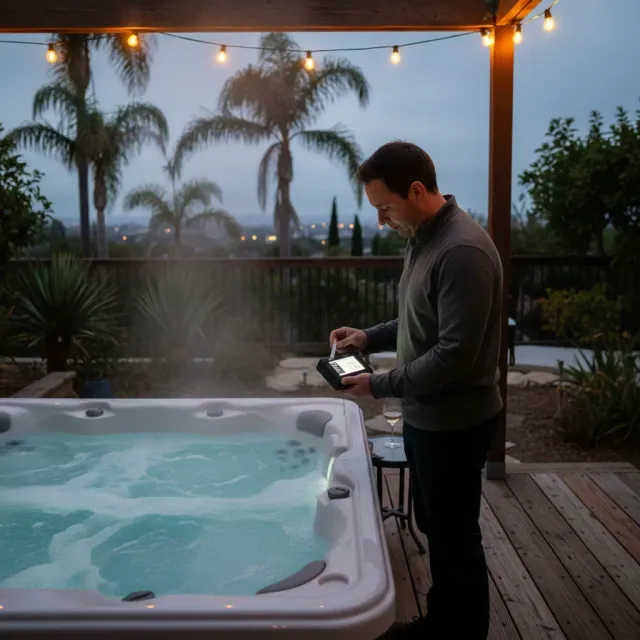
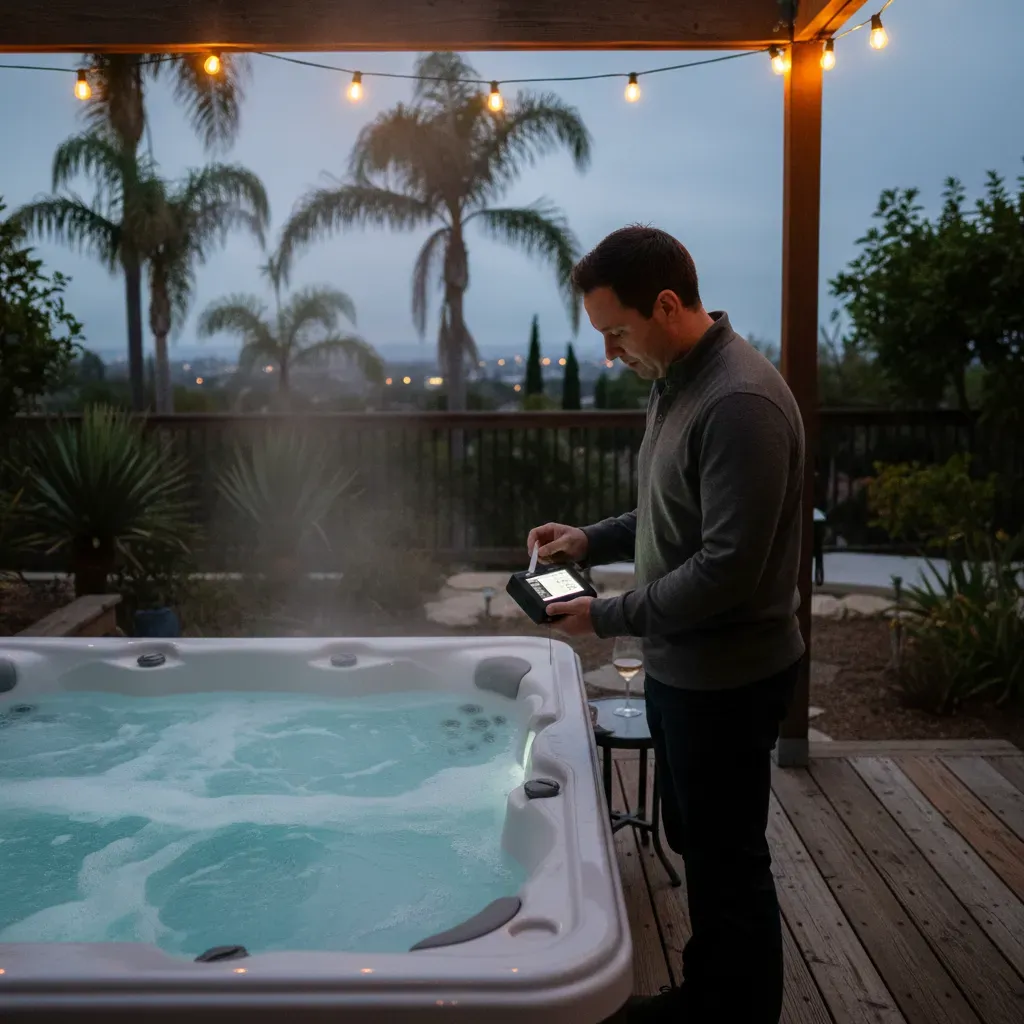
Maintain your hot tub by testing sanitizer and pH before use, removing debris, cleaning filters, and replacing water when dissolved buildup becomes difficult to manage. Keep pH between 7.2 and 7.8, and follow your spa manual and sanitizer label for the remaining targets.
Our approach starts with the spa's water volume, sanitizer system, and filter instructions. Record these beside your test results so chemical additions match the actual tub.
| When | What to check | What triggers action |
|---|---|---|
| Before use | Sanitizer, pH, water clarity, and water level | Correct out-of-range readings before soaking |
| After use or dusty winds | Floating debris and sanitizer demand | Remove debris and test before deciding whether to add sanitizer |
| Weekly | Waterline, filter condition, alkalinity, and cover | Clean visible buildup and investigate drifting chemistry |
| At refills and after substantial top-ups | Source-water hardness and complete water balance | Adjust treatment to the new readings |
| At the manual's service intervals | Filter deep cleaning, replacement, and water changes | Service sooner if condition or water quality requires it |
How often do you need to put chemicals in a hot tub?
Add chemicals according to test results and product instructions, rather than adding the same dose every day. A heavily used tub may need attention after each session. An unused, covered tub still needs regular testing because sanitizer does not remain effective indefinitely.
Use a test kit designed for your sanitizer system. A chlorine test must measure free chlorine, not just total chlorine. Bromine systems need a bromine reading. Salt systems also need sanitizer testing because the generator produces sanitizer rather than replacing it.
- Take a sample away from return jets before adding chemicals. Follow the kit's sampling instructions.
- Check total alkalinity when pH repeatedly drifts. Adjust it to the spa manufacturer's range before chasing pH with repeated doses.
- Adjust pH and sanitizer using products approved for your spa and its measured water volume.
- Add products separately. Never mix concentrated chemicals together.
- Allow the labeled circulation time, then retest before use.
Shock treatment oxidizes accumulated contaminants, but the product and timing depend on the sanitizer system. Nonchlorine shock does not replace a sanitizer residual. Follow the label for dosing, ventilation, and reentry instead of assuming that a fixed waiting period applies to every product.
Clean filters and jets when flow or condition changes
Inspect the filter weekly and rinse it when debris collects between its pleats. Heavy use, sunscreen, and windblown dirt can shorten the interval between cleanings. Follow the manual's schedule for soaking it in an approved cartridge cleaner.
Switch off equipment as directed before removing the cartridge. Rinse between the pleats with a garden hose; pressure washers can damage filter material. After chemical cleaning, rinse thoroughly so cleaner residue does not return to the tub.
Replace a cartridge with torn pleats, damaged end caps, or persistent restriction after cleaning. Appearance alone cannot confirm that an oily cartridge is clean.
For weak jets, first check the water level, adjustable jet positions, and filter condition. Weak flow after a refill may indicate trapped air. Follow the model's priming procedure, and stop the pump if it cannot establish flow. Persistent noise or flow errors need equipment diagnosis rather than repeated chemical additions.
Remove surface debris and clean the waterline
Skim leaves and insects when you see them, before they reach the filter. Wipe the waterline with a soft cloth and a spa-approved cleaner when an oily ring appears. Household detergents can leave residues that cause foam.
Santa Ana winds bring dry dust, leaves, and pollen into uncovered water. After a wind event, inspect the tub and filter even if the next scheduled cleaning is several days away. Clear debris from the cover before opening it.
Showering before soaking helps reduce lotions and body oils entering the water. Rinse swimwear thoroughly after laundering. If foam persists, investigate detergent residue, accumulated contaminants, and water balance before repeatedly adding defoamer. Defoamer suppresses the symptom without removing its source.
Manage San Diego's hard source water
Much of San Diego County's tap water comes from imported sources and carries substantial dissolved minerals. Test calcium hardness at each refill rather than assuming the previous fill's reading still applies. Use the target specified for your spa's materials and equipment.
Evaporation leaves minerals behind. Repeated top-ups can therefore increase mineral concentration, especially during hotter inland weather. Check hardness again when top-ups become frequent or scale begins forming.
High pH increases the tendency for calcium scale to form. Correct water balance before treating visible deposits, and use only scale products compatible with your spa. Scale-control products do not remove calcium from the water.
A standard hose sediment filter does not reliably soften hard water. If hardness exceeds your spa's recommended range, determine a suitable fill-water approach before draining. Avoid filling entirely with softened water unless the manufacturer permits it and provides balancing instructions.
Protect the cover and adjust operation for local weather
Keep the cover secured between uses and inspect its fit, straps, and underside during routine cleaning. Remove dirt with products approved for the cover material. Use UV protectant only where the manufacturer recommends it; do not apply general-purpose protectants to the spa shell.
Coastal salt air makes exposed metal equipment worth checking for corrosion. Inland heat increases evaporation, while colder inland nights increase heating demand. Check water level more often during hot, dry periods and inspect cover gaps before cooler weather.
For a tub used regularly, leave its normal filtration and temperature controls operating according to the manual. Repeatedly cutting power interrupts filtration and may disable freeze protection. For longer absences, use the manufacturer's vacation or economy settings while arranging continued water checks.
Whether maintaining temperature uses less energy than reheating depends on insulation, weather, settings, and time between uses. Start with a well-fitting cover and appropriate temperature settings. Do not reduce filtration below the manufacturer's requirements to save electricity.
Know when to drain, clean, and refill
Follow your spa manual's water-change interval, then shorten it when use and water condition warrant. Persistent foam, recurring cloudiness, or chemistry that becomes difficult to control can justify replacement after checking filtration and dosing. San Diego's climate alone does not establish a universal drain schedule.
- Use a compatible plumbing cleaner before draining when the manual calls for it. Follow its circulation and rinsing instructions.
- Disconnect power as directed before lowering the water. Never run the heater or pump dry.
- Drain using the approved method, clean the shell with a spa-safe product, and rinse away residue.
- Clean or replace the filter according to its condition.
- Refill through the location specified in the manual. Some models require filling through the filter compartment to reduce trapped air.
- Restore circulation using the startup procedure, balance the fresh water, and confirm sanitizer before use.
Our hot tub draining and refilling guide explains the process in more detail. Keep the model's startup instructions nearby during the refill.
Use symptoms to decide when to call for service
Home maintenance is manageable when readings stay predictable and equipment runs normally. Stop troubleshooting by trial and error when the same symptom returns after the appropriate cleaning or adjustment.
- Cloudy water despite corrected readings: Check filter condition and circulation before adding more products.
- Repeated sanitizer loss: Review usage, dosing, and accumulated contamination. Increasing the dose without identifying the cause can prolong the problem.
- Flow errors or unusual pump noise: Stop operation if water is not circulating and arrange diagnosis.
- Leaks, recurring heater faults, or breaker trips: Stop using the equipment and request service. Do not repeatedly reset a tripping breaker.
PoolLogic Pool Service provides hot tub cleaning and maintenance in San Diego County. Our technicians check water condition, filtration, and equipment operation to identify the next step. Send the spa model, recent test readings, and any displayed error code when arranging service.

Kyle Bowman
Founder of PoolLogic · CPO-Certified
Kyle is the Founder of PoolLogic Pool Service and a Certified Pool Operator (CPO) with deep expertise in pool service, water chemistry, and pool equipment repair. He oversees every aspect of PoolLogic's operations to ensure San Diego pool owners receive expert-level care.
Read moreNeed professional pool service?
PoolLogic Pool Service provides expert pool cleaning, maintenance, and repair services throughout San Diego County.