
On this page
- Stop the chlorine feed before choosing a treatment
- Check whether the chlorine reading is trustworthy
- Match the readings and symptoms to the cause
- Check stabilizer and sunlight before deciding to wait
- Choose measured neutralization or dilution when waiting is impractical
- Confirm the endpoint and prevent another rise
Stop the chlorine feed before choosing a treatment
To reduce chlorine in a pool, stop adding chlorine and let sunlight and normal chlorine demand lower the reading. For faster correction, use a pool chlorine neutralizer according to its label, based on measured free chlorine and pool volume.
Turn off a salt system's chlorine production or an automatic chlorine feeder while maintaining circulation. Keep swimmers out until testing confirms the water meets the sanitizer label's swimming requirements. Do not use swimming as a way to consume excess chlorine.
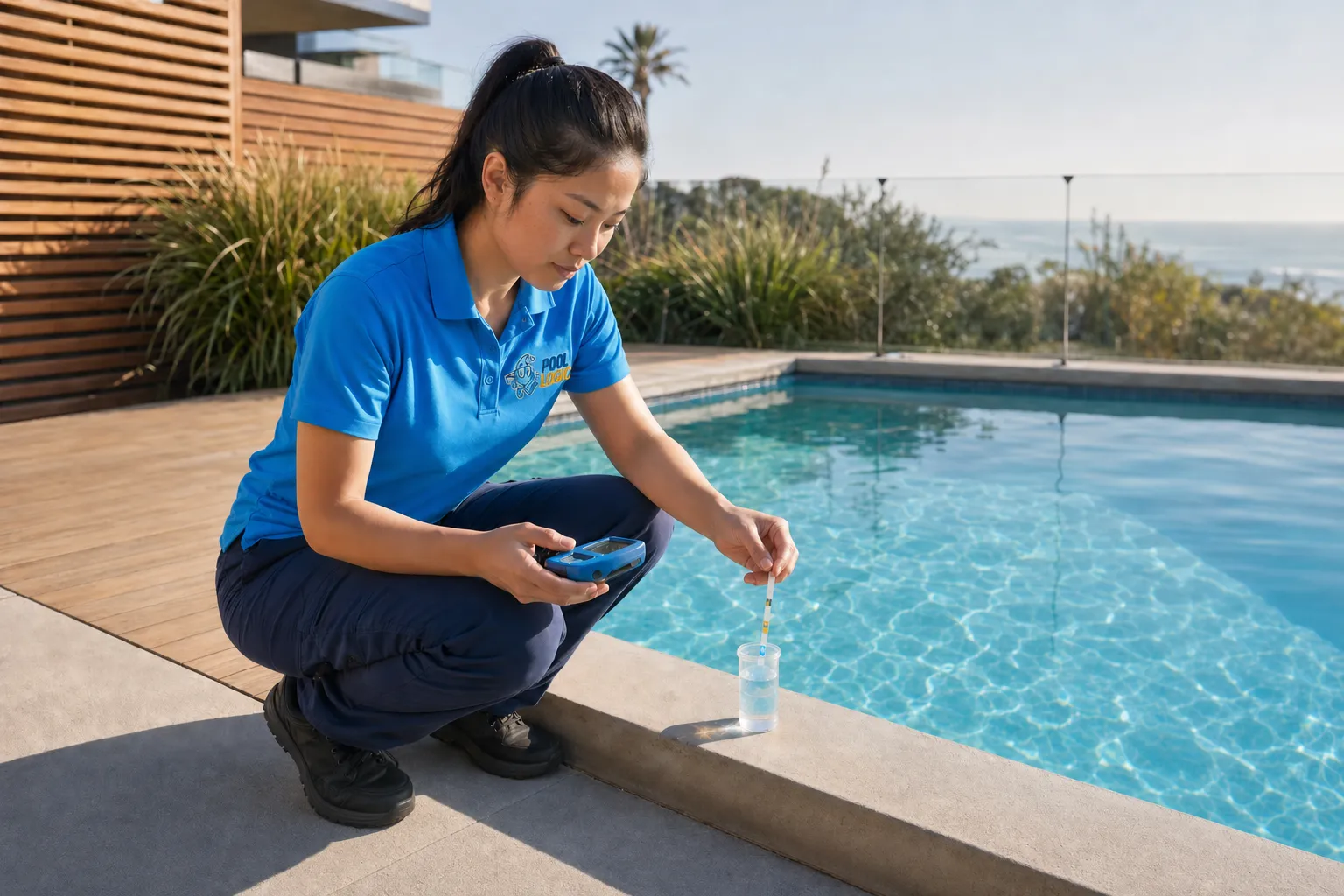
Our technicians first confirm whether free chlorine is actually excessive. A strong smell, irritated eyes, or a dark test strip cannot determine the treatment alone. We check free chlorine, total chlorine, pH, and cyanuric acid before deciding how much chlorine to remove. The goal is a suitable sanitizer residual, never zero chlorine.
Check whether the chlorine reading is trustworthy
Take a sample about elbow depth, away from return jets and floating dispensers. Follow the test kit's timing and sample-volume instructions. Water collected beside a chlorine source can give a misleading picture of the pool.
Free chlorine measures the available sanitizer. Total chlorine includes free chlorine and combined chlorine. Subtract free chlorine from total chlorine to calculate combined chlorine. For example, total chlorine of 5 ppm and free chlorine of 4.5 ppm gives 0.5 ppm combined chlorine.
A chlorine titration drop test helps when a color comparator reaches its upper limit. Use a test with a measurement range that covers the suspected concentration. Very high chlorine can bleach some color-based chlorine tests, producing a falsely low or clear result. A clear test immediately after a large chlorine dose needs verification before adding anything else.
Check the pH test's interference limit, too. High chlorine can distort some phenol-red pH readings. Do not add acid solely because an affected test appears unusually high. Confirm the result using the kit manufacturer's procedure.
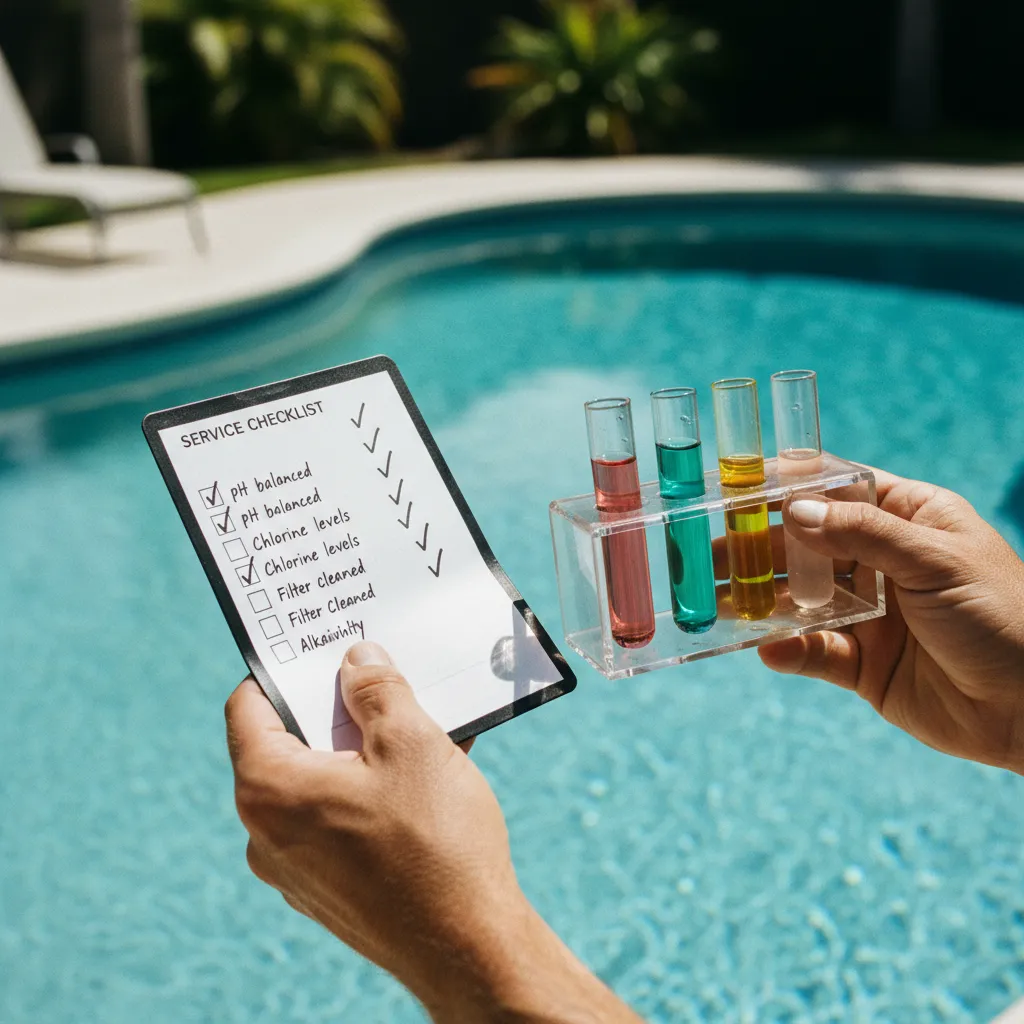
Match the readings and symptoms to the cause
Once the readings are reliable, we compare them with recent dosing and equipment settings. This sequence separates a one-time overdose from a feeder problem or combined chlorine issue.
| Reading or symptom | Likely cause to check | Next decision |
|---|---|---|
| High free chlorine after a manual dose or shock treatment | Too much product, overlapping treatments, or an underestimated product strength | Pause dosing and track the decline before choosing neutralizer. |
| Free chlorine rises again without manual dosing | Salt-system boost mode, feeder settings, or an active dosing schedule | Check every chlorine source and confirm production has stopped. |
| Strong odor with a measurable gap between total and free chlorine | Combined chlorine from reactions with contaminants | Investigate contamination and sanitation needs before removing free chlorine. |
| Unexpectedly low or clear test after heavy chlorination | Test bleaching or a concentration beyond the kit's range | Verify with a suitable test before treating the water. |
| High free chlorine declines slowly under a cover | Limited sunlight exposure, low demand, or elevated cyanuric acid | Check stabilizer and cover use before assuming the feeder is faulty. |
Chlorine shock raises free chlorine initially. It is not a treatment for an already excessive free-chlorine reading. Combined chlorine may require a different oxidation strategy, but smell alone is not a reason to add shock or neutralizer.
Check stabilizer and sunlight before deciding to wait
Cyanuric acid, also called stabilizer or CYA, slows chlorine loss from sunlight. Measure it before predicting how quickly chlorine will drop. The same free-chlorine reading behaves differently in water with little stabilizer and water with elevated stabilizer.
If the excess is modest and swimming can wait, sunlight is often the simplest correction. Open the cover only when access remains safely controlled. Maintain circulation for mixing and representative testing. A standard pool filter removes particles; it does not directly remove dissolved chlorine.
In coastal San Diego County, marine-layer mornings can make sunlight-driven chlorine loss slower than homeowners expect. Inland summer conditions generally increase chlorine demand, but heat alone cannot predict a correction time. Retest later the same day and again before swimming instead of assuming an overnight wait is enough.
Do not add stabilizer to lower chlorine. It can prolong chlorine's persistence. Baking soda also does not neutralize chlorine; it raises total alkalinity. Neither product solves an overdose.
If free chlorine remains steady or rises after dosing stops, recheck the feed equipment and repeat the measurement. Waiting longer will not solve an active chlorine source.
Choose measured neutralization or dilution when waiting is impractical
A pool chlorine neutralizer, commonly based on sodium thiosulfate, can reduce free chlorine faster than waiting for sunlight. Its dose depends on three inputs: pool volume, the desired reduction in ppm, and the product's concentration. There is no universal scoop size.
For example, lowering a verified reading from 8 ppm to a selected target of 4 ppm requires a 4 ppm reduction. That example describes the calculation, not a target for every pool. Choose the endpoint using the sanitizer label and the pool's stabilizer level.
Follow the neutralizer label's application and circulation instructions. Retest after its specified mixing interval before adding more. Excess neutralizer can remove the sanitizer residual and consume chlorine added afterward. Never mix concentrated pool chemicals together or add neutralizer directly into a chlorine feeder.
Dilution deserves consideration when elevated CYA or accumulated minerals also need correction. Replacing water solely for a modest chlorine excess is usually unnecessary. San Diego County's hard, mineral-heavy tap water also means refill water brings calcium back into the pool. Test source water and pool water before choosing replacement.
A theoretical 25 percent water replacement reduces chlorine by about 25 percent if replacement water contains no chlorine and mixing is complete. Actual source water may contain disinfectant. We assess water chemistry and equipment before recommending a pool draining and restart service.
Confirm the endpoint and prevent another rise
Before reopening the pool, check free chlorine against the sanitizer label's swimming range and confirm pH is within 7.2 to 7.8 using a reliable test. Water should be clear enough to see the bottom. Clear appearance alone does not establish acceptable chemistry.
Once the correction is complete, restart chlorine production at a setting matched to current demand. Check these controls before returning to the previous schedule:
- Cancel any salt-system boost or superchlorinate mode.
- Check whether longer pump hours also increased chlorine production time.
- Confirm automatic dosing schedules do not overlap manual additions.
- Record free chlorine, CYA, the treatment used, and the next reading.
Compare readings at roughly the same time on consecutive days. A rising trend means chlorine input still exceeds demand. San Diego pools operate year-round, so an inland summer setting can become excessive during cooler months or extended covered periods.
If chlorine repeatedly climbs after adjustments, our technicians check the feeder, salt-system controls, and dosing schedule. We confirm the equipment fix after inspecting the system. Our weekly pool cleaning service in San Diego provides ongoing chemistry checks so adjustments follow measured demand.

Kyle Bowman
Founder of PoolLogic · CPO-Certified
Kyle is the Founder of PoolLogic Pool Service and a Certified Pool Operator (CPO) with deep expertise in pool service, water chemistry, and pool equipment repair. He oversees every aspect of PoolLogic's operations to ensure San Diego pool owners receive expert-level care.
Read morePool service done right
Need professional pool service?
PoolLogic Pool Service provides expert pool cleaning, maintenance, and repair services throughout San Diego County.