
On this page
- Raise free chlorine to a target based on stabilizer
- Check free chlorine, pH, and CYA before dosing
- Use the CYA reading to choose the operating target
- Check what consumed or stopped producing chlorine
- Select chlorine without adding unwanted calcium or stabilizer
- Calculate the dose, circulate, and retest
- Use follow-up readings to decide the next step
Raise free chlorine to a target based on stabilizer
Raise free chlorine by adding a measured dose of pool chlorine, then circulate and retest. For an outdoor pool with 40 ppm cyanuric acid (CYA), aim for about 4 to 5 ppm free chlorine, adjusting the operating target with the stabilizer reading.
The dose depends on pool volume and the difference between the current reading and that target. For example, raising 10,000 gallons from 1 to 5 ppm takes approximately 51 fluid ounces of 10% liquid pool chlorine, before accounting for chlorine demand.
Leaves, algae, and other contaminants can consume chlorine before the next test. Adding the calculated amount does not prove the pool reached its target. At PoolLogic Pool Service, we confirm the readings, investigate the cause, select the product, dose, and verify.
Check free chlorine, pH, and CYA before dosing
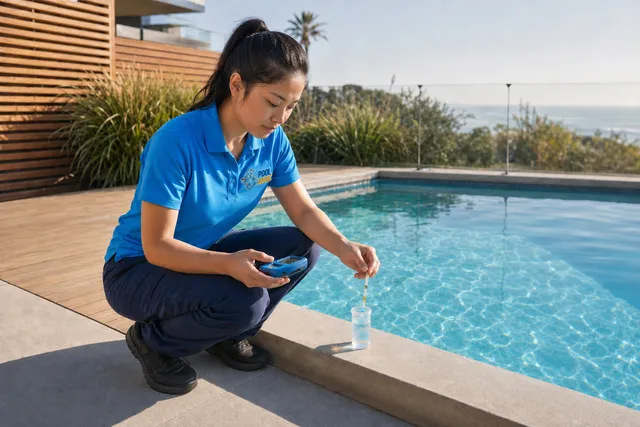
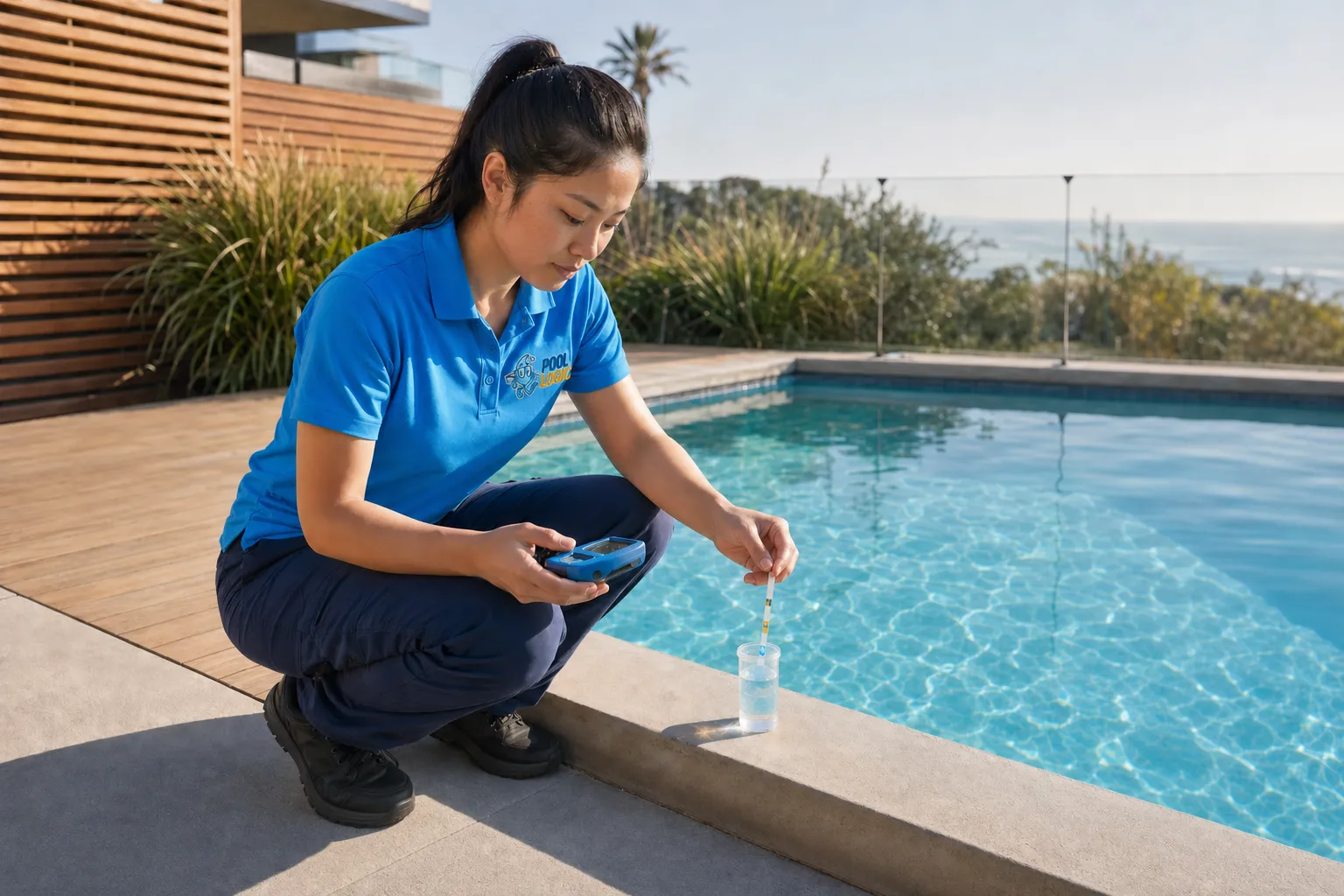
Our technicians start with a water sample away from return jets and floating dispensers. Sampling directly beside a chlorine source can produce a misleadingly high reading.
We distinguish three chlorine readings:
- Free chlorine: the chlorine available to sanitize the water.
- Total chlorine: free chlorine plus combined chlorine.
- Combined chlorine: total chlorine minus free chlorine, representing chlorine that has reacted with contaminants.
A total chlorine reading of 3 ppm and free chlorine reading of 0.5 ppm means combined chlorine is 2.5 ppm. Treating the total reading as available sanitizer would miss the problem.
We also check pH and cyanuric acid, often called stabilizer. A pH reading outside the usual pool range of 7.2 to 7.8 needs attention. Changing pH alone does not add free chlorine.
If a zero chlorine result conflicts with recent heavy dosing, confirm it using a test suitable for higher concentrations. Very high chlorine can bleach some color tests and resemble a zero reading. Resolve that mismatch before adding another dose.
Use the CYA reading to choose the operating target
Stabilizer protects chlorine against sunlight, but higher CYA requires more free chlorine to maintain effective sanitation. For routine correction in a manually chlorinated outdoor pool, use an operating target of roughly 10% to 12.5% of the CYA reading. Multiply CYA by 0.10 and 0.125 to calculate that range.
| CYA reading | Approximate free chlorine operating target |
|---|---|
| 30 ppm | 3 to 3.75 ppm |
| 40 ppm | 4 to 5 ppm |
| 50 ppm | 5 to 6.25 ppm |
| 60 ppm | 6 to 7.5 ppm |
These are routine operating targets, not algae treatment levels or swimming clearance limits. Choose a target that leaves room for normal chlorine loss before the next test. For a saltwater pool, follow the generator manufacturer's paired CYA and free chlorine guidance; continuous production can change the operating recommendation. Do not apply this ratio to water with no stabilizer.
If CYA is already so high that the calculated target exceeds the product's permitted operating range or cannot be maintained reliably, arrange a partial drain and refill. More chlorine does not remove excess CYA. Stop adding stabilized chlorine while correcting the problem.
With CYA-free refill water, the estimated replacement fraction equals 1 minus desired CYA divided by current CYA. Reducing 100 ppm CYA to 50 ppm requires replacing approximately half the water. That estimate assumes water is removed before refilling; staged exchanges require more total water. Evaporation and topping off do not remove CYA.
Our pool draining and restart service can assess an appropriate partial water replacement. After refilling and circulating, retest CYA before calculating chlorine. San Diego's hard refill water also makes a fresh calcium hardness test useful.
Check what consumed or stopped producing chlorine
Before dosing, we look for debris, slippery surfaces, cloudy water, and weak return flow. This separates a routine shortfall from an active contamination problem or equipment fault.
Santa Ana winds can deposit leaves, dirt, and pollen in a single day. Removing that material reduces the load chlorine must handle. We check baskets and circulation before expecting a chemical addition to distribute evenly.
In hotter inland San Diego County pools, summer conditions increase chlorine demand and evaporation. A dose or salt-system setting that worked during cooler weather may stop maintaining the target. Coastal marine-layer mornings do not justify skipping the test either: outdoor pools still lose chlorine during daylight.
For a saltwater pool, we inspect the controller's output setting, operating schedule, flow status, and warning messages. The cell produces chlorine only while its operating conditions are satisfied. Adding salt does not immediately raise free chlorine, and increasing output cannot correct a failed cell.
San Diego's hard source water also makes scale worth checking on salt cells. We confirm the appropriate cleaning, repair, or equipment replacement after seeing the equipment. If the controller reports a fault, our saltwater pool equipment repair service can address the production problem.
Select chlorine without adding unwanted calcium or stabilizer
The product choice matters because chlorine products add different substances to the water. Our technicians compare the existing calcium and CYA readings before selecting a corrective treatment.
| Product | What it adds | Decision rule |
|---|---|---|
| Liquid pool chlorine | Chlorine without calcium or CYA | Useful for a measured correction when calcium or stabilizer is already sufficient. |
| Calcium hypochlorite | Chlorine and calcium | Check calcium hardness before using it repeatedly. |
| Dichlor or trichlor | Chlorine and CYA | Track stabilizer accumulation; slow-dissolving tablets are unsuitable for a rapid correction. |
| Non-chlorine shock | Oxidizer without a free chlorine dose | Do not use it to raise the free chlorine reading. |
Imported, mineral-heavy tap water and evaporation can leave San Diego pools with elevated calcium hardness. Repeated calcium hypochlorite additions can increase that burden. Liquid chlorine often makes sense when the immediate task is raising free chlorine without adding more calcium or stabilizer.
Baking soda is not a substitute. It raises total alkalinity and supplies no chlorine.
Calculate the dose, circulate, and retest
The required increase equals the selected target minus the measured free chlorine. Suppose a 10,000-gallon pool has 40 ppm CYA and reads 1 ppm free chlorine. Choosing the upper end of its 4 to 5 ppm operating range gives a target of 5 ppm. The required increase is 4 ppm.
With fresh 10% liquid pool chlorine, approximately 12.8 fluid ounces raises 10,000 gallons by 1 ppm. Multiply 12.8 by four for a starting dose of approximately 51 fluid ounces. A 20,000-gallon pool needs twice that amount for the same increase.
For this product strength, the calculation is: fluid ounces = 12.8 × (pool gallons ÷ 10,000) × required ppm increase. Different product strengths require different doses, so the container's dosing instructions control.
CYA changes the dose even when pool volume and starting chlorine stay the same. At 60 ppm CYA, selecting a 6 ppm target instead would require a 5 ppm increase from that same 1 ppm reading. The approximate dose becomes 64 fluid ounces for 10,000 gallons.
These are calculated increases before chlorine demand. Liquid chlorine also loses strength during storage, especially in heat. An old container may deliver less than the calculation predicts.
- Confirm pool volume, product strength, and the required ppm increase.
- Keep swimmers out and establish circulation before dosing.
- Wear the protection specified on the label and apply the product exactly as directed.
- Keep chlorine products separate from acids and other chemicals. Never mix products in a container or reuse a feeder for an incompatible product.
- Circulate for the label's required interval, then collect a fresh sample away from the addition point.
For planning, an initial mixing check may fall around 30 to 60 minutes after a liquid addition when circulation is effective. That interval is not a universal swimming clearance or a substitute for label instructions. Weak circulation or treatment for algae can require a different schedule.
If the measured increase falls short, we recheck the dose, product condition, circulation, and chlorine demand before adding more. Green water or a rapid return to zero calls for a treatment plan with repeated testing. Our pool algae removal service addresses that situation.
Use follow-up readings to decide the next step
Before swimming, confirm that chlorine and pH meet the product's swimming requirements and that the pool bottom is clearly visible. A timer alone cannot establish that treatment is complete.
After correcting low chlorine, test again the following day. Record the time, free chlorine reading, and any chemical addition. Comparing readings taken at similar times helps distinguish a one-time shortfall from a recurring supply problem.
- Target reached after mixing, then low the next day: review daily chlorine supply, debris, and swimmer demand.
- Target never reached after mixing: verify pool volume, product strength, testing, and circulation before calculating another addition.
- Chlorine repeatedly returns to zero: arrange a water and equipment check instead of repeating an unmeasured dose.
- A salt system shows a fault: record the message and have the production issue checked.
Our weekly pool cleaning service in San Diego supports ongoing water testing and maintenance. Between visits, tell us about a recurring low reading promptly. Share the test time, CYA reading, product used, amount added, and any controller message so we can determine the next step.

Kyle Bowman
Founder of PoolLogic · CPO-Certified
Kyle is the Founder of PoolLogic Pool Service and a Certified Pool Operator (CPO) with deep expertise in pool service, water chemistry, and pool equipment repair. He oversees every aspect of PoolLogic's operations to ensure San Diego pool owners receive expert-level care.
Read morePool service done right
Need professional pool service?
PoolLogic Pool Service provides expert pool cleaning, maintenance, and repair services throughout San Diego County.