
On this page
- Why is my swimming pool green?
- Check whether the green color comes from algae or metals
- Compare free chlorine with stabilizer before calling it adequate
- Use a measured algae treatment, then remove the particles
- What to check when the pool stays green after treatment
- Adjust prevention to San Diego heat, wind, and year-round use
- When to arrange professional algae removal
Why is my swimming pool green?
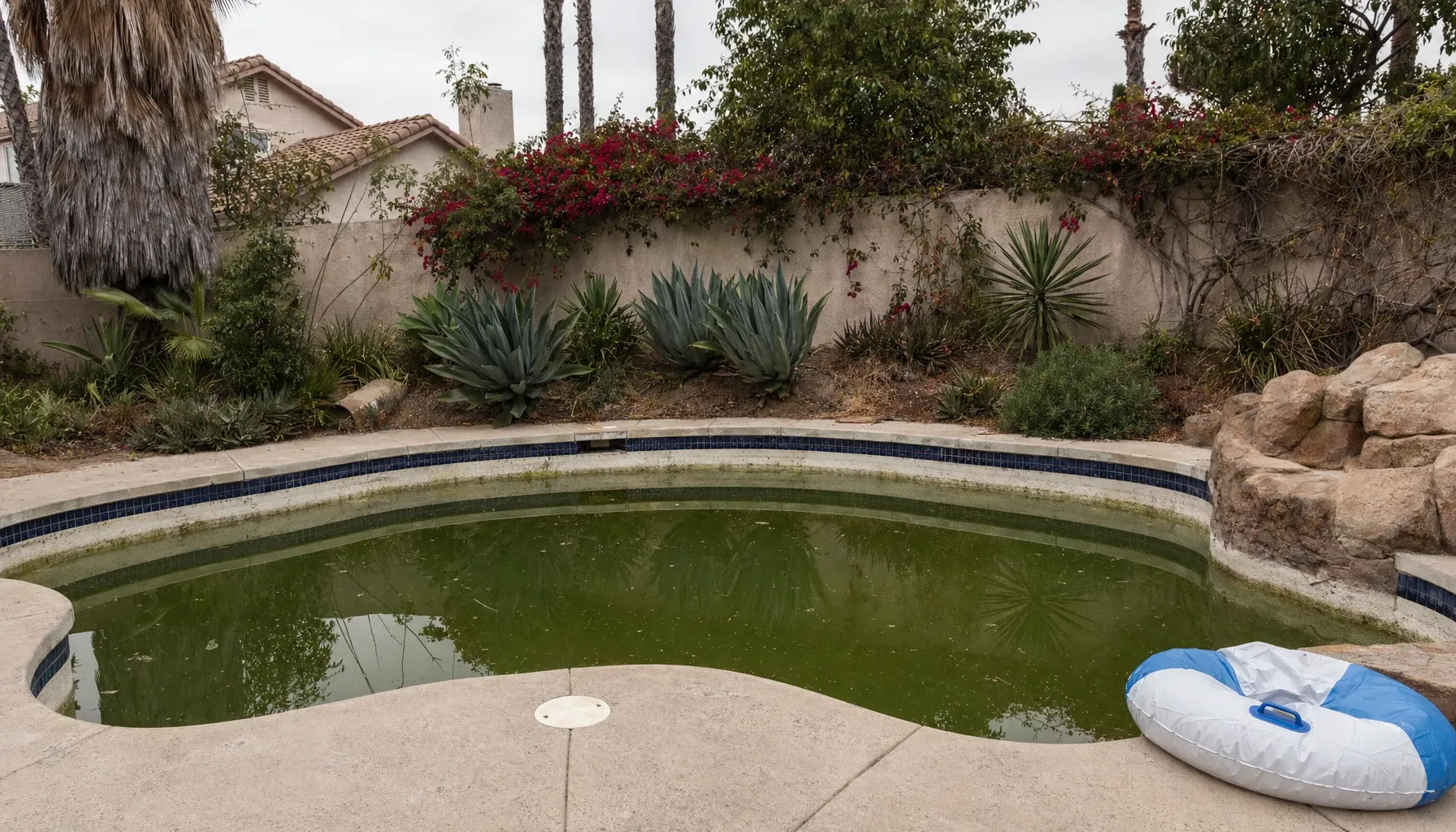
Green pool water usually means algae are growing because available chlorine cannot keep up with demand. Fix algae with measured chlorine treatment, brushing, and filtration; clear green water can instead signal dissolved metals, which need a different treatment.
Low chlorine, excessive stabilizer, poor circulation, and accumulated debris can all contribute. Before adding chemicals, check whether the water is cloudy, whether surfaces feel slippery, and whether the color appeared immediately after adding chlorine. These clues help you choose the right tests rather than repeat a treatment that misses the cause.
Check whether the green color comes from algae or metals
| What you notice | What it suggests | What to check next |
|---|---|---|
| Cloudy green water with slippery walls or visible growth | Algae are likely present | Test free chlorine, pH, and cyanuric acid, then check circulation |
| Transparent green water, especially after chlorine treatment | Oxidized metals, particularly copper, may be coloring the water | Test for metals and review recently added products |
| Green patches return around steps or behind ladders | Attached algae or weak circulation may remain | Brush these areas and check return flow |
| Water stays cloudy after the green fades | Suspended particles may still need removal | Retest chlorine and inspect filter pressure and flow |
Appearance guides testing but does not confirm the cause. Algae and metals can occur together. If a pool turns greener immediately after shocking, test for metals before adding another dose.
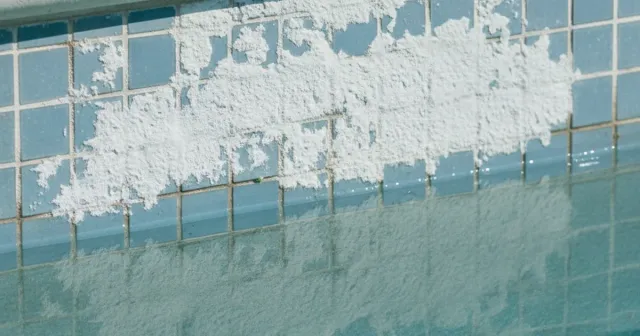
San Diego County's imported tap water is generally hard, and evaporation concentrates minerals further. Hardness itself does not identify a green tint as copper. Test calcium hardness separately, particularly before choosing calcium hypochlorite, a chlorine product that also adds calcium. Repeatedly topping up an evaporating pool replaces water without removing accumulated minerals.
For confirmed metals, treatment may involve a compatible sequestrant to control discoloration and a plan to address the metal source. Review copper-containing algae products and recently added water when investigating that source. Sequestration does not remove metals from the water. Our technicians choose the next step after checking the water and equipment.
Compare free chlorine with stabilizer before calling it adequate
A chlorine reading does not always mean the water has enough effective sanitizer. Check free chlorine, rather than relying only on total chlorine, and measure cyanuric acid, also called CYA or stabilizer.
CYA protects chlorine from sunlight, but it also changes how much chlorine is needed. For ordinary green algae in stabilized water, our working treatment target is about 40 percent of the CYA reading. Multiply CYA in ppm by 0.40 to estimate the free chlorine treatment target in ppm.
For example, at 40 ppm CYA, the treatment target is about 16 ppm free chlorine. A normal operating level is much lower, for example about 4 to 5 ppm free chlorine at that same CYA reading. Maintaining normal operating chlorine after algae appear is different from holding an algae treatment target.
That comparison makes a test result useful: 2 ppm free chlorine at 40 ppm CYA is below that operating example. A reading of 5 ppm meets the example operating range, but falls well below the treatment target once green algae are established. The 40 percent rule is a treatment guide for ordinary green algae, not a swimming limit or a target for every kind of discoloration.
- Stabilized chlorine can change the comparison. Repeated use of trichlor or dichlor raises CYA over time. An unchanged chlorine reading can become inadequate as stabilizer accumulates.
- A single reading misses earlier shortages. Testing immediately after dosing can hide periods when sanitizer was depleted. Record readings before the next scheduled addition as well.
- Debris increases chlorine demand. Leaves and organic material consume chlorine during cleanup. A calculated dose is only useful if testing confirms the target is being maintained.
- Circulation can leave problem areas. A running pump does not prove that water moves effectively through the filter and around steps.
Saltwater pools can turn green for the same reasons. Their salt cells produce chlorine, and production may fall short because of settings, operating time, scale, or equipment faults. Check controller warnings and measure free chlorine before increasing output. In hard local water, inspect for cell scale according to the manufacturer's instructions rather than assuming a higher output setting will solve low production.
Use a measured algae treatment, then remove the particles
The treatment logic is simple: test the water, adjust pH, brush attached growth, hold a measured chlorine target, and filter the remaining particles. Test pH before raising chlorine substantially, because high chlorine can interfere with some pH tests. Resolve weak circulation so treatment can reach the affected areas.
Use our step-by-step pool algae removal guide for the CYA-based target table, dosing math, testing intervals, and end-of-treatment checks. Calculate additions from pool volume and product strength, and follow chemical handling instructions. Never mix chemicals together.
Chlorine kills algae, but filtration removes the suspended remains. A change from green to cloudy gray or blue can mean particle removal is now the main task. Avoid adding several clearing products at once, which makes results harder to interpret.
What to check when the pool stays green after treatment
If free chlorine falls quickly, treatment demand remains high. Recheck debris, attached growth, and the treatment calculation. If chlorine holds but the green tint remains transparent, revisit metal testing.
If water remains cloudy and return flow weakens, inspect filtration. Compare filter pressure with the clean-filter reading at the same pump speed. Pressure readings taken at different speeds can mislead you. Follow the manufacturer's cleaning threshold instead of assuming one pressure limit fits every filter.
A loaded filter can slow cleanup, while damaged internal components may allow particles back into the pool. Our pool filter cleaning service can help when accumulated debris is restricting filtration. Continued particle return after cleaning calls for an equipment inspection.
Clearing time depends on the amount of algae, water chemistry, and filtration capacity. An overnight result is not a reliable deadline. Keep swimmers out while the cause remains unresolved or the floor cannot be seen clearly. Before reopening, complete the treatment checks and confirm chemistry meets the product label's swimming limits. Water color alone cannot establish that treatment is complete.
Adjust prevention to San Diego heat, wind, and year-round use
- Check chlorine daily during inland heat spells. Inland and East County summer heat raises chlorine demand and evaporation. Compare readings taken at a consistent time to see whether your routine keeps up. Settings that worked through cool coastal mornings may fall short during hotter conditions.
- Clear baskets after Santa Ana winds. These hot, dusty winds can deposit leaves, dirt, and pollen in a day. Remove debris and check sanitizer after the wind event. A basket packed with leaves adds organic demand and can restrict water movement.
- Inspect after the first winter storm. Rain after a dry spell washes accumulated dust and debris into pools. Check what entered the water before deciding on a chemical addition; weather alone does not establish a need for extra treatment.
- Match pump operation to measured performance. Required operating time depends on speed, flow, filter condition, and sanitizer equipment. With San Diego's high electricity rates, extending pump hours indefinitely can be costly. If flow is weak, find the restriction instead of relying on more hours.
- Keep a routine through cooler months. San Diego pools operate year-round. Reduced swimming does not eliminate the need to check chemistry, brush sheltered areas, and empty baskets.
For an ongoing maintenance routine, see our guide to preventing recurring pool algae.
When to arrange professional algae removal
Arrange help if algae return after a complete treatment, the floor remains hidden, chlorine readings are difficult to interpret, or circulation is weak. A green tint following chemical additions also calls for diagnosis before further dosing.
For our San Diego pool algae removal service, we check water chemistry, visible growth, circulation, and filtration to choose the next steps. Equipment problems may require service or repair alongside water treatment. Review our San Diego pool service pricing when planning professional treatment.
Before the visit, gather your latest free chlorine, CYA, and pH readings, product names, recent doses, and equipment warnings. Include when each reading was taken relative to dosing. Tell us when the color changed and whether it followed a storm, a pump interruption, or a chemical addition. Those details help us distinguish an inadequate treatment target from continuing demand, poor filtration, or metals.
FAQ
Frequently asked questions
Will baking soda clear a green pool?
No. Baking soda raises total alkalinity; it does not kill algae or remove metals. Use it only when an alkalinity test indicates an adjustment is needed.
Will clarifier or phosphate remover get rid of algae?
Clarifier helps a compatible filter capture fine particles, but it does not kill algae. Phosphate remover reduces a nutrient algae can use, but it does not replace sanitizer, brushing, or filtration. Neither should be the first response to an undiagnosed green pool.

Kyle Bowman
Founder of PoolLogic · CPO-Certified
Kyle is the Founder of PoolLogic Pool Service and a Certified Pool Operator (CPO) with deep expertise in pool service, water chemistry, and pool equipment repair. He oversees every aspect of PoolLogic's operations to ensure San Diego pool owners receive expert-level care.
Read morePool service done right
Need professional pool service?
PoolLogic Pool Service provides expert pool cleaning, maintenance, and repair services throughout San Diego County.