
On this page
Start with testing and identify the growth
To get rid of green algae in a stabilized pool, maintain free chlorine at about 40 percent of cyanuric acid while brushing, filtering, and vacuuming. At 40 ppm cyanuric acid, that means a 16 ppm free chlorine treatment target.
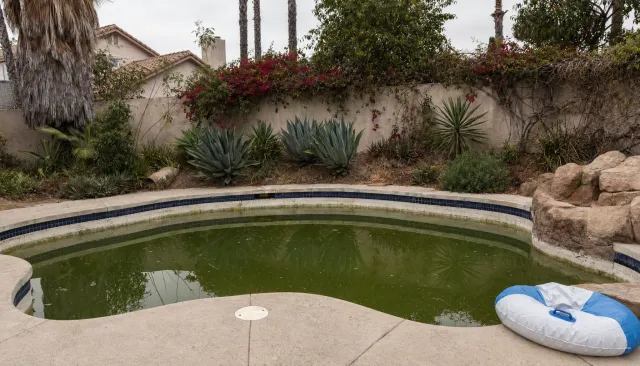
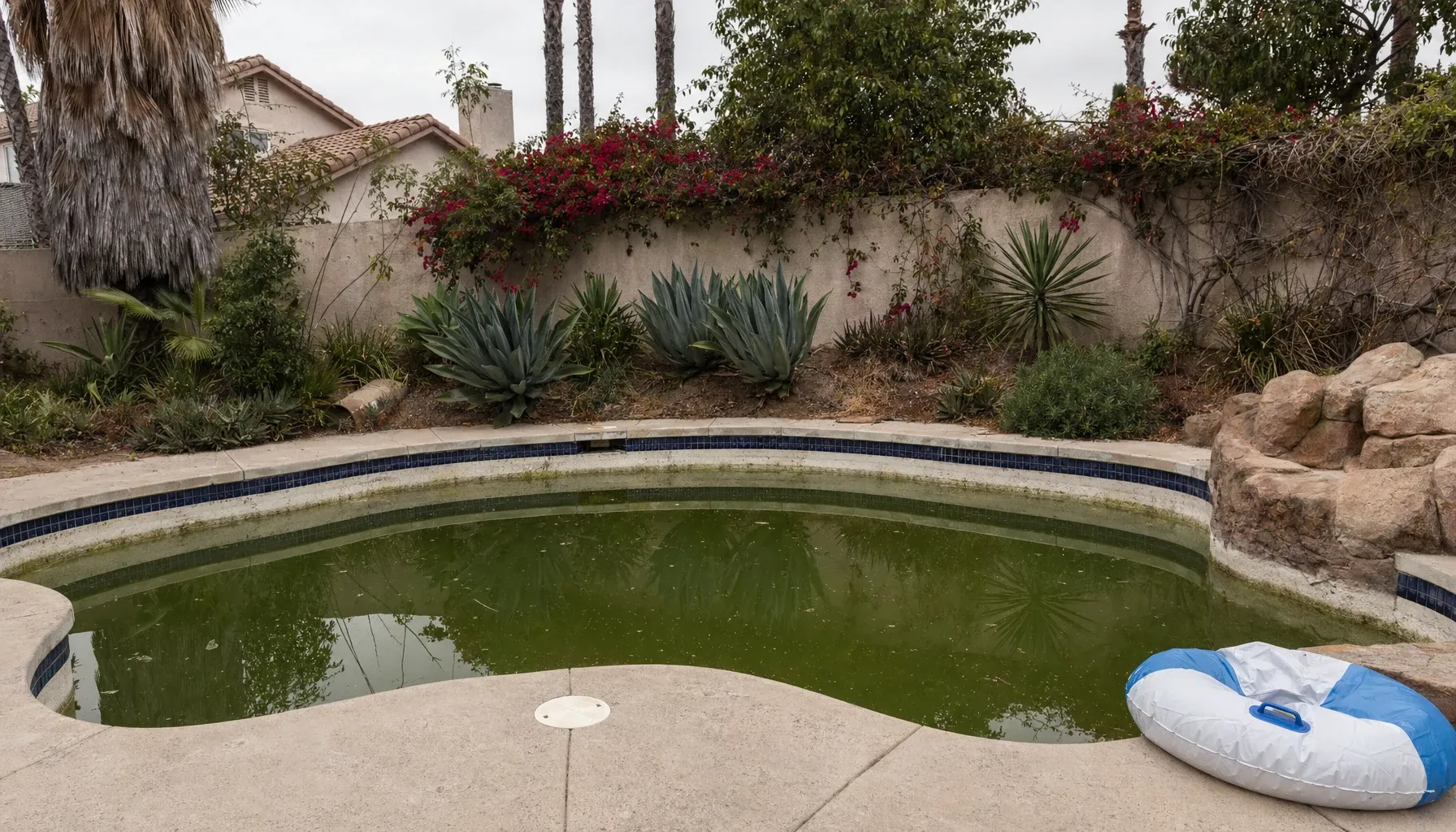
Keep swimmers out during treatment. Start by checking whether growth covers the pool or stays in specific spots. Widespread slippery growth suggests inadequate sanitation. Growth behind steps or around ladders also points toward poor brushing access or weak water movement.
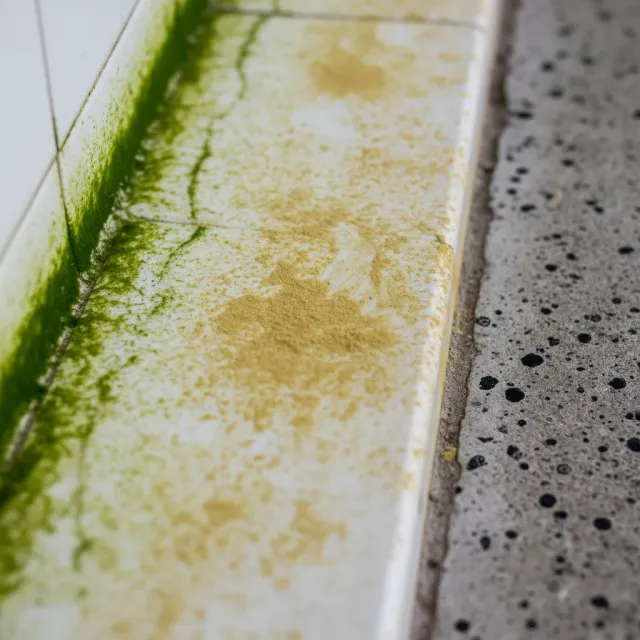
Brush a small reachable patch with a brush approved for your pool's surface. A coating that loosens into a cloud may be algae, although settled dirt behaves similarly. Transparent green water with little attached material can indicate dissolved metals. Test for metals before escalating chlorine treatment in that situation. A fixed mark needs identification before stronger treatment.
This procedure focuses on ordinary green algae. Yellow growth that repeatedly returns in shaded areas and stubborn dark spots need closer assessment. Our guide to pool algae types and their removal needs explains those differences. Avoid using a more aggressive brush before confirming compatibility with the surface.
Algae removal usually does not require emptying the pool. Start with testing, sanitation, circulation, and physical removal. If water chemistry prevents effective treatment, our technicians determine the next step from the readings and equipment.
Which symptom points to which cause?
Use these observations to choose the next check. More than one problem can occur together, such as inadequate chlorine and a filter loaded with debris.
| What you observe | Possible cause | Next check |
|---|---|---|
| Slippery growth across walls and floor | Insufficient effective sanitizer | Measure free chlorine, pH, and cyanuric acid. |
| Growth behind steps or ladders | Sheltered surfaces or weak local circulation | Check brushing access and return direction. |
| Clear water with a green tint | Dissolved metals | Test for metals before adding more algae products. |
| Chlorine falls rapidly after treatment | Continuing demand from algae or organic debris | Check debris load and whether treatment levels are being maintained. |
| Growth fades but cloudiness remains | Suspended residue, poor filtration, or mineral cloudiness | Check flow, filter condition, pH, and calcium hardness. |
| Weak returns with rising filter pressure | Filter loading or another restriction | Compare pressure with the clean baseline at the same pump speed. |
| Weak returns with low pressure or persistent air | Suction restriction, low water level, or air entry | Check water level, baskets, and pump priming. |
After Santa Ana winds, remove leaves, dirt, and pollen before judging treatment performance. These winds can fill a San Diego pool with debris within a day. Net accessible material and empty baskets using the equipment's shutdown procedure.
A pump that runs dry or repeatedly loses prime needs attention before treatment continues. Extra chemicals cannot compensate for water that is not circulating.
Set the chlorine target from three water readings
Measure free chlorine, pH, and cyanuric acid before choosing a treatment dose. Sample away from return jets and chemical feeders. Use a chlorine test that measures the expected treatment range, such as a powder-and-drop titration kit. A result beyond the kit's scale cannot guide another addition.
Measure the free chlorine remaining
Measure the current residual before calculating each dose. Yesterday's addition may already be consumed. Chlorine must remain available throughout treatment, so one large addition followed by an unchecked decline can leave surviving growth.
Adjust pH before raising chlorine
Bring pH to about 7.2 to 7.4 before raising chlorine to the treatment target. Elevated chlorine can interfere with common pH tests, often above 10 ppm. Check your kit's limit and avoid adjusting pH from an unreliable reading during treatment.
If pH repeatedly drifts or is difficult to adjust, check total alkalinity. Repeated correction doses without understanding the cause can create another balance problem.
Use cyanuric acid to set treatment strength
For ordinary green algae in stabilized water, use a free chlorine target of about 40 percent of the cyanuric acid reading. Multiply cyanuric acid, also called CYA or stabilizer, by 0.4.
| Cyanuric acid | Free chlorine treatment target |
|---|---|
| 30 ppm | 12 ppm |
| 40 ppm | 16 ppm |
| 50 ppm | 20 ppm |
| 60 ppm | 24 ppm |
| 70 ppm | 28 ppm |
Across over 11,000 San Diego cyanuric acid readings, our median is 40 ppm, with the middle 80 percent from 20 to 70 ppm. At that median, the treatment target is 16 ppm free chlorine. Test your own stabilizer before dosing because a pool at 70 ppm needs a different target.
Cyanuric acid protects chlorine from sunlight but reduces the fraction immediately active. A measurable chlorine residual does not automatically mean algae treatment is adequate. These are temporary treatment targets, not routine operating levels.
The 40 percent rule does not apply to unstabilized water. If CYA is zero or exceeds your test's range, establish an appropriate treatment plan before dosing. Keep chemical use within product and equipment instructions; our technicians can resolve a target that conflicts with those limits.
Will shock get rid of algae?
Yes. Chlorine-based shock can kill algae when it reaches attached growth and maintains the treatment target. Nonchlorine shock does not replace an algae-killing sanitizer. Brushing and follow-up testing are essential parts of treatment.
Calculate the required chlorine increase by subtracting the current free chlorine reading from the target. For example, a pool with 40 ppm CYA and 2 ppm free chlorine needs an increase of 14 ppm to reach 16 ppm.
One gallon of 10 percent liquid chlorine raises free chlorine in about 10,000 gallons of water by roughly 10 ppm. For that pool, a 14 ppm increase requires about 1.4 gallons. A 20,000-gallon pool needs about 2.8 gallons for the same increase. These estimates assume the stated product strength; ongoing chlorine demand can lower the reading after addition.
Use actual pool volume and the concentration on the container. Different-strength products require different quantities. Retest rather than assuming the calculated dose reached and held the target.
- Remove bulk debris. Net leaves and clear accessible baskets. Confirm pool volume before calculating chemicals.
- Brush affected surfaces. Reach walls, steps, corners, and ladder areas with a surface-compatible brush. Work from the deck without entering cloudy water.
- Confirm steady circulation. Check return flow and that the pump stays primed. Keep water near the middle of the skimmer opening, within the equipment's operating requirements.
- Add the calculated chlorine dose. Follow the product label's application method and handling precautions. Never mix chemicals together or combine different chlorine products in a feeder or container.
- Retest after 30 to 60 minutes of circulation. Use the new reading to calculate any additional chlorine needed to restore the target.
- Maintain treatment and continue brushing. Test every one to two hours while chlorine demand is high. As demand slows, test morning, afternoon, and evening. Replenish to the target from each measured reading, and brush at least daily while growth remains.
Choose chlorine with the existing water balance in mind. Liquid pool chlorine adds neither calcium nor cyanuric acid. Calcium hypochlorite adds calcium; dichlor and trichlor add stabilizer. San Diego County's imported source water is mineral-heavy, and evaporation concentrates those minerals. Check calcium hardness before repeated calcium-based treatments.
Inland heat raises chlorine demand and evaporation. Keep the shorter testing intervals when readings fall quickly. Coastal marine-layer mornings do not establish adequate sanitation either. Let measured chlorine determine additions.
For saltwater pools, check cell alerts, salt level, operating time, and actual chlorine production. Normal generator output may not catch up with an active bloom. Use measured liquid-chlorine additions when needed to reach the target. A boost setting is useful only if testing confirms that it maintains that level.
Clean the filter at a 20 to 25 percent pressure rise
To clean algae from pool surfaces and water, combine brushing with vacuuming and filtration. Chlorine kills growth, but the remaining particles still need physical removal. Pale or cloudy water after treatment may contain suspended residue.
Compare filter pressure with its clean baseline at the same pump speed and valve settings. Clean when pressure rises about 20 to 25 percent, unless the manufacturer specifies otherwise. For example, a clean baseline of 16 psi gives a cleaning trigger near 19 to 20 psi. If you lack a baseline, record pressure after proper cleaning and normal operation resumes.
Cartridge filters require cleaning of trapped material from their pleats. Sand filters commonly use backwashing. Diatomaceous earth filters require the correct replacement media after backwashing or cleaning, according to the model's instructions.
Shut down equipment and fully relieve pressure before opening a filter. Never loosen a pressurized closure or move a multiport valve while the pump runs. Our pool filter cleaning service can address debris loading that stalls recovery. We confirm the cleaning method after seeing the equipment.
To remove algae from the pool bottom, vacuum settled residue slowly without stirring it into suspension. Vacuuming to waste can bypass the filter when the system supports it and an appropriate discharge destination is available. Watch the water level and stop before the skimmer draws air.
If the system lacks a waste setting, use suitable filtration and expect additional filter cleaning. A cleaner that stirs up a cloud without collecting the particles is not completing removal. If debris repeatedly returns through the jets, inspect the filter for bypass or damaged internal parts.
Run filtration continuously, 24 hours a day, during active cleanup while the pump remains primed and flow stays reliable. Check pressure at each chlorine test because heavy residue can load a filter quickly. Longer operation cannot overcome a blocked filter. After adding replacement water, retest chemistry because dilution changes the readings.
What kills algae besides chlorine?
Some algaecides kill algae; others are intended primarily for prevention. Check the product's active ingredient and labeled use before adding it. An algaecide does not replace maintaining the pool's sanitizer.
| Product | Useful role | Decision before use |
|---|---|---|
| Algaecide | Targeted treatment or prevention, depending on the label | Confirm the algae type and compatibility with current treatment. |
| Clarifier | Helps compatible filters capture small suspended particles | Confirm filtration works and fine residue is the remaining problem. |
| Flocculant | Settles particles for physical removal | Confirm compatibility with the system and that settled material can be removed as directed. |
| Phosphate remover | Reduces a nutrient source | Address sanitizer and debris first; it does not directly kill an existing bloom. |
Copper-containing algaecides can contribute to staining as metals accumulate. Check existing metal exposure and water balance before adding one, especially if the water is tinted but transparent.
Avoid adding several products because the pool remains cloudy. Identify whether the remaining problem is live growth, suspended material, or mineral imbalance. Each calls for a different response.
Use four checks to end treatment and reopen the pool
Pool algae cleanup can take several days, with longer recovery when growth is heavy or circulation is impaired. A lighter green color alone does not confirm recovery. End treatment only when all four conditions are met:
- The water is clear.
- No visible algae remains.
- Overnight free chlorine loss is 1 ppm or less.
- Combined chlorine is 0.5 ppm or less.
For the overnight test, restore the treatment target after sunset and allow 30 to 60 minutes of circulation. Measure and record free chlorine, then test again before sunlight reaches the pool. Keep circulation running, but turn off salt-cell production and automatic chlorine feeding during the comparison. Add no chlorine between those two readings.
Subtract the morning reading from the evening reading. If the loss exceeds 1 ppm, continue treatment and retest the next night. Keep treating if combined chlorine remains above 0.5 ppm or either visual condition fails, even when overnight loss passes.
After all four checks pass, allow chlorine to fall to the normal operating target for your measured CYA. At 40 ppm CYA, let free chlorine fall to about 4 to 5 ppm before reopening. Confirm pH is 7.2 to 7.8 and the deepest floor is clearly visible. Also observe any additional swimming restrictions for products used during cleanup.
Restore normal chlorination as the level approaches its operating target. Resume the regular filtration schedule once the water is clear and filter pressure is stable.
- Chlorine repeatedly falls: verify pool volume, product strength, test accuracy, stabilizer, and remaining debris.
- Chlorine holds but spots remain: reassess brushing access and whether the marks are algae.
- Growth disappears but clarity stalls: inspect filtration and mineral balance before adding another treatment.
- Flow fails or readings exceed your kit's range: arrange help before continuing chemical additions.
For our San Diego pool algae removal service, send current chlorine, pH, and stabilizer readings with their test times. Include pool volume if known, recent product names and amounts, filter pressure, and pump settings. Photographs of the water, affected surfaces, and equipment labels help our technicians prepare.
Once the pool recovers, use our pool algae prevention guide to adjust ongoing care. Increase debris checks after Santa Ana winds and the first winter storms. Keep testing through cooler coastal weather because San Diego pools operate year-round.
Frequently asked questions
Should pool toys and removable accessories be cleaned during treatment?
Yes. Clean toys, brushes, removable ladders, and other wet accessories using methods compatible with their materials. Pay attention to folds, undersides, and other areas that shelter residue. Follow each item's instructions before exposing it to treatment-level chlorine.
Can old test reagents lead to the wrong algae treatment?
Yes. Expired reagents or supplies damaged by heat can produce unreliable readings. Check expiration dates and storage instructions. Replace suspect reagents or have the water tested before using an unexpected result to calculate another dose.
Will a robotic cleaner remove algae by itself?
No. A robotic cleaner collects debris and brushes accessible surfaces, but it does not sanitize the water. Fine residue may pass through its filter. Check the cleaner's permitted chlorine range before running it during treatment.

Kyle Bowman
Founder of PoolLogic · CPO-Certified
Kyle is the Founder of PoolLogic Pool Service and a Certified Pool Operator (CPO) with deep expertise in pool service, water chemistry, and pool equipment repair. He oversees every aspect of PoolLogic's operations to ensure San Diego pool owners receive expert-level care.
Read moreNeed professional pool service?
PoolLogic Pool Service provides expert pool cleaning, maintenance, and repair services throughout San Diego County.