
On this page
- Total alkalinity tells you how well water resists pH changes
- Alkalinity, pH, and hardness measure different things
- Use the reading and pH trend to choose your next step
- Confirm the result and separate top-offs from water replacement
- Choose between monitoring, a measured adjustment, and service
- Have these details ready before the next adjustment
Total alkalinity tells you how well water resists pH changes
Total alkalinity measures your pool water’s ability to neutralize acid and resist sudden pH changes. A common starting range is 80 to 120 parts per million (ppm), with the target adjusted for your sanitizer and equipment guidance.
If alkalinity is within your pool’s recommended range and pH stays steady, leave it alone. Confirm an unexpected reading before adding chemicals. If pH repeatedly swings or climbs despite careful adjustments, have the water balance checked together.
Most of that resistance comes from bicarbonate dissolved in the water. It acts as a buffer, meaning it softens the effect of added acid. Too little buffering lets pH drop quickly after an acid addition. Excess alkalinity can contribute to recurring upward pH drift as dissolved carbon dioxide escapes.
At PoolLogic Pool Service, we use alkalinity alongside pH and other water readings to decide whether a pool needs an adjustment. An alkalinity result alone does not tell you which chemical to add.
Alkalinity, pH, and hardness measure different things
If your test shows acceptable pH but high alkalinity, both results can be correct. They measure different properties. Hard water adds another separate concern, especially in San Diego County.
| Test | What it measures | How it helps you decide |
|---|---|---|
| Total alkalinity | The water’s capacity to neutralize acid | Use 80 to 120 ppm as a common starting range, then check your system’s target. |
| pH | How acidic or basic the water is now | A usual pool range is 7.2 to 7.8. Check it before choosing an alkalinity treatment. |
| Calcium hardness | The amount of dissolved calcium | Check it separately when investigating mineral deposits or cloudy water. |
A pH of 7.6 does not establish that alkalinity is correct. Likewise, alkalinity of 100 ppm does not establish that pH or chlorine is correct.
Your kit may report alkalinity as calcium carbonate equivalents, a standard way to express acid-neutralizing capacity. That wording does not make it a calcium hardness test. San Diego County’s hard, mineral-heavy tap water makes this distinction useful: test both readings instead of assuming they rise together.
The word “total” matters, too. The test includes contributions from substances besides bicarbonate, including stabilizer, also called cyanuric acid. When assessing whether water may form mineral deposits, our technicians account for stabilizer’s contribution instead of treating the entire alkalinity reading as bicarbonate.
Use the reading and pH trend to choose your next step
Treat 80 and 120 ppm as guideposts, not automatic chemical dosing instructions. Your sanitizer type, equipment recommendations, and pH behavior help determine the right target.
- Below 80 ppm: Confirm the result and check the recommended range. If pH drops sharply after small acid additions, insufficient buffering may be part of the problem.
- Between 80 and 120 ppm: If this matches your system’s guidance and pH remains steady, extra alkalinity increaser serves no useful purpose.
- Above 120 ppm: Confirm the reading and watch for repeated pH rise. Review calcium hardness as well, because elevated pH and calcium can encourage mineral deposits.
When alkalinity keeps falling, review what you have added. Repeated acid additions and acidic chlorine tablets containing trichlor pull alkalinity down over time. Record product names and amounts so you can distinguish that pattern from changes after adding water.
If alkalinity stays steady while pH climbs, check water movement and the sanitizer system. Splashing and bubbling, called aeration, release dissolved carbon dioxide and raise pH without raising alkalinity. Saltwater chlorine systems can also encourage this pattern. Check fountains, spa spillovers, and returns that splash, then compare your readings with the salt-system manufacturer’s targets.
White deposits on equipment call for calcium hardness, pH, and water temperature checks alongside alkalinity. Those conditions together affect scale, a hard mineral deposit. Lowering alkalinity alone may miss why deposits keep returning.
Water appearance cannot diagnose alkalinity. Clear water can have poor balance, while cloudy water may involve filtration, sanitation, or calcium. Adding an alkalinity product because the pool looks cloudy can make the chemistry harder to correct.
Record the next pH reading before another addition. One acceptable reading immediately after treatment can hide a recurring rise between treatments.
Confirm the result and separate top-offs from water replacement
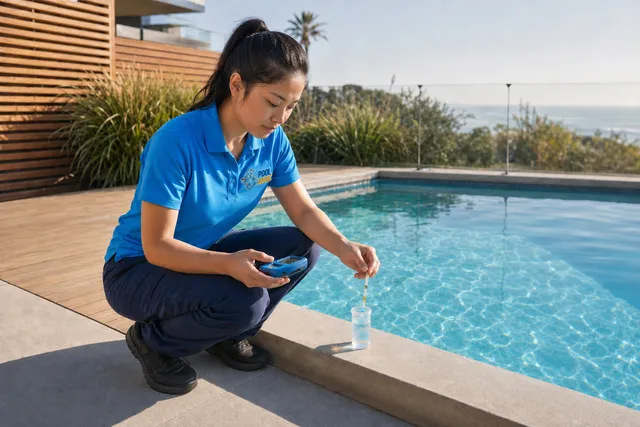
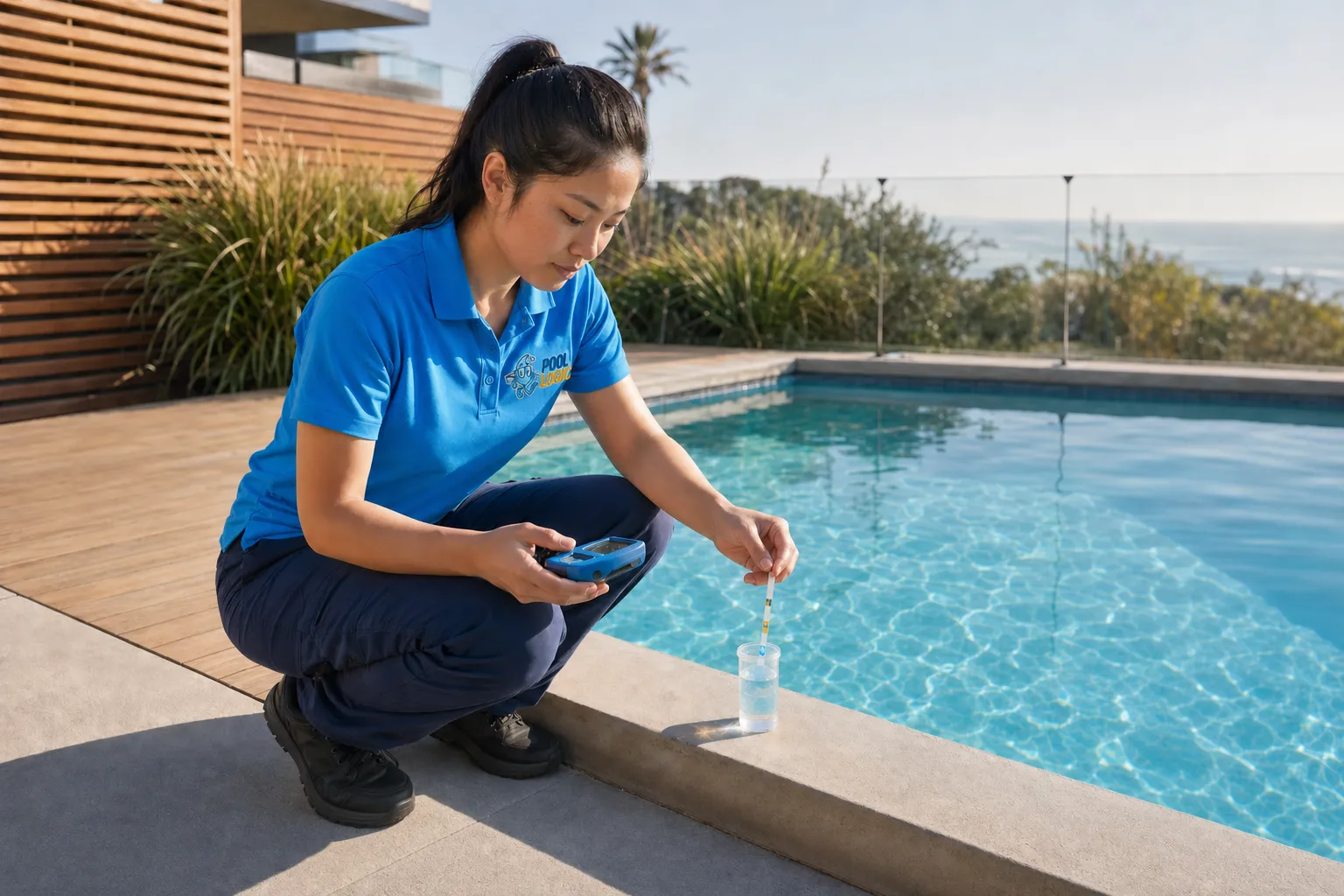
A drop test gives you a more useful basis for a measured adjustment than guessing between similar strip colors. Follow the kit’s directions for sample size, test drops, and the final color change. Different sample sizes can change how many ppm each drop represents.
- Collect water below the surface, away from return jets and recent chemical additions.
- Use test drops within their stated shelf life and storage requirements.
- Test pH and total alkalinity during the same testing session.
- Follow the kit’s instructions for interference from high sanitizer levels.
- Repeat an unexpected result before calculating a dose.
Most San Diego County tap water comes from imported Colorado River and Northern California supplies. It arrives hard and mineral-heavy. Test the actual fill water’s alkalinity and calcium hardness when readings keep returning after water additions.
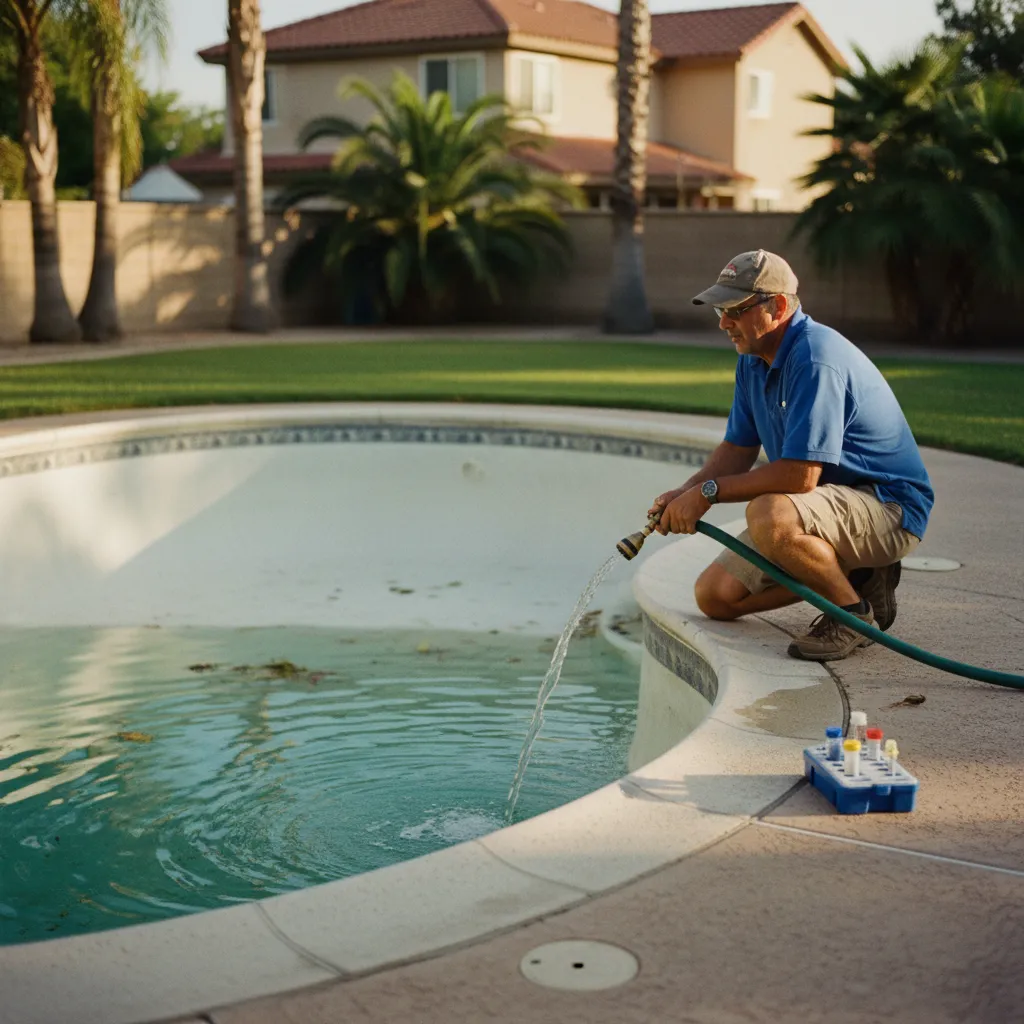
Replacing evaporation does not remove the alkalinity already in your pool. Evaporation leaves it behind, and the top-off adds whatever alkalinity the fill water contains. Even fill water with lower alkalinity than the pool cannot lower the pool’s alkalinity below its pre-evaporation reading through topping off alone.
Replacing water that actually leaves is different. Backwashing, splash-out, rain overflow, or a partial drain removes dissolved alkalinity along with water. Lower-alkalinity replacement water can then dilute what remains. Higher-alkalinity replacement water can raise it.
| Illustrative water change | What happens to alkalinity |
|---|---|
| A 10,000-gallon pool at 150 ppm loses 1,000 gallons to evaporation, then receives fill water at 80 ppm. | At its original volume, alkalinity becomes about 158 ppm. The original alkalinity stayed in the pool, and the fill water added more. |
| The same pool loses 1,000 gallons of pool water, then receives fill water at 80 ppm. | At its original volume, alkalinity becomes about 143 ppm. Some alkalinity left with the removed pool water. |
These examples assume complete mixing and no other chemical changes. They explain why a hose-water reading below the pool’s reading is not enough to predict a decrease. You also need to know how the water was lost.
Hotter inland San Diego summers increase evaporation compared with the milder coast. Record frequent top-offs separately from backwashing or other water loss. During hot, dry Santa Ana winds, record water additions and remove windblown debris before testing. Compare readings at the same normal water level so evaporation does not confuse the trend.
The first winter storm after a dry spell washes accumulated dust, phosphates, and debris into local pools. Record whether it merely raised the water level or caused overflow. If water turns cloudy afterward, remove debris and check sanitizer and filtration alongside water balance before choosing a treatment.
Choose between monitoring, a measured adjustment, and service
Monitor when the water is stable
If confirmed readings match your system’s targets, continue testing instead of purchasing correction chemicals. Check alkalinity weekly and after substantial water replacement. Test pH and sanitizer more frequently according to your pool’s needs. Monitoring alkalinity does not replace those checks.
Adjust it yourself when the result and dose are clear
A measured adjustment is reasonable when you know the pool volume, have reliable readings, and can follow the product label. Sodium bicarbonate raises alkalinity with a relatively small effect on pH. Soda ash raises pH more strongly and also increases alkalinity. Check the ingredient label, and use soda ash only when pH also needs to rise.
Acid lowers both alkalinity and pH. Aeration can then raise pH without restoring the alkalinity removed by acid. This is why lowering high alkalinity may require staged adjustments and retesting, rather than one large acid addition.
If pH is already low, adding acid simply to chase a high alkalinity number can make conditions worse. Use our guides to raising pool alkalinity or lowering pool alkalinity safely once you know which direction is needed.
Allow time for label-directed circulation and retesting before another addition. Never mix pool chemicals, and keep acid and chlorine products separate. Wear the protection specified on the label. Overshooting is a particular risk when pool volume or product strength is uncertain.
Get help when corrections keep reversing
Call when repeated measured adjustments fail to hold, tests disagree, or mineral deposits keep returning. Our technicians check water readings, chemical use, fill water, and equipment operation before choosing the next adjustment. We confirm equipment-related changes after seeing the equipment.
For ongoing care, our Monthly Residential Pool Service, with one cleaning per week, is $175. See San Diego pool service pricing and our weekly pool cleaning service for the available service option.
Have these details ready before the next adjustment
Before treating the water or contacting our team, gather four details:
- Your latest alkalinity and pH readings, including when you tested.
- The pool volume and the sanitizer system you use.
- The name and amount of each recently added chemical.
- Recent water additions, whether they replaced evaporation or lost pool water, and the fill-water alkalinity if tested.
If any of those details are uncertain, resolve them before calculating a chemical dose. Keep swimmers out during treatment and follow the product’s return-to-swimming instructions. An acceptable alkalinity reading alone never establishes that the water is ready for swimming; pH, sanitizer, and visibility also matter.

Kyle Bowman
Founder of PoolLogic · CPO-Certified
Kyle is the Founder of PoolLogic Pool Service and a Certified Pool Operator (CPO) with deep expertise in pool service, water chemistry, and pool equipment repair. He oversees every aspect of PoolLogic's operations to ensure San Diego pool owners receive expert-level care.
Read moreNeed professional pool service?
PoolLogic Pool Service provides expert pool cleaning, maintenance, and repair services throughout San Diego County.