
On this page
Phosphates enter with debris, runoff, water, and products
Phosphates get into pool water through soil, fertilizer runoff, leaves, pollen, some fill water, and certain pool products. Before buying a phosphate remover, check what entered the pool before the reading increased.
Phosphates are phosphorus-containing compounds that algae can use as nutrients. Some arrive dissolved in water. Others become available as leaves and other organic material break down. Water can look clear while containing measurable phosphate, so appearance alone cannot identify the source.
In San Diego County, Santa Ana winds can drop dust, leaves, and pollen into a pool within a day. The first winter storm after a dry spell can wash accumulated material into the water. If your reading rose after either event, start by checking debris and runoff paths.
A high phosphate result alone does not establish why a pool turned green or cloudy. Our first step is to connect the reading with recent water additions, yard work, weather, and product use.
Run this ten-minute check before calling
Use these ten minutes to gather clues. You do not need to finish a cleanup or complete every water test during this check.
- Minutes 1 and 2: Check the water and your latest readings. Note visible algae, cloudiness, free chlorine, pH, and the phosphate result with its units. Free chlorine is the chlorine available to sanitize the water. A phosphate number without these details gives an incomplete picture. Keep swimmers out if cloudiness hides the pool bottom.
- Minutes 3 and 4: Look for incoming debris. Check the surface, steps, bottom, and skimmer opening for leaves, pollen, grass clippings, or dirt. A fresh accumulation after wind points toward material entering from the yard or surrounding area.
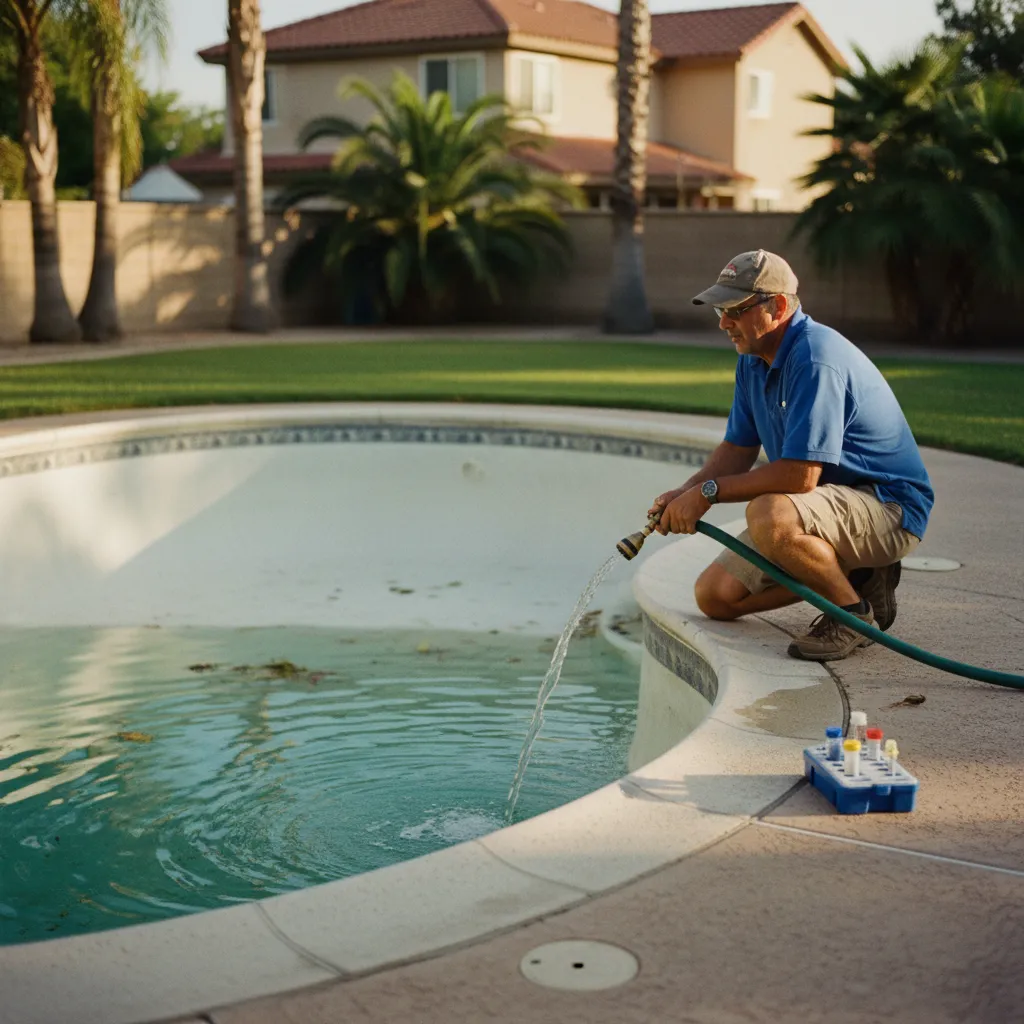
- Minutes 5 and 6: Walk the pool edge. Look for soil trails, fertilizer granules, or sprinkler spray reaching the water. A trail from a planting bed suggests runoff. Photograph it before cleaning so its path remains easy to explain.
- Minutes 7 and 8: Review recent additions. Note top-offs, a refill, fertilizer use, and any stain or scale products. Keep product labels available. Timing helps narrow the search, although it does not prove a source.
- Minutes 9 and 10: Observe circulation. While the pump runs normally, note unusually weak return flow and the filter pressure. Compare pressure at the same pump speed with the recorded clean-filter reading. Do not open equipment during this check.
Weak circulation, recurring algae, or chlorine that repeatedly falls below its required level calls for a technician. Visible debris with normal circulation gives you a clear first action: remove the material before it breaks down.
Match each clue to a likely entry route
| What you notice | Possible phosphate source | What to check next |
|---|---|---|
| Leaves, pollen, or dust after Santa Ana winds | Windblown soil and organic material | Remove debris promptly and prevent collected material from blowing back into the pool. |
| Dirty water tracks after rain or irrigation | Soil and fertilizer carried by runoff | Identify where water crossed the pool edge and keep irrigation spray away. |
| A higher reading after repeated top-offs | Phosphate in replacement water, if present | Test the actual fill source alongside the pool. |
| A rise after stain or scale treatment | A phosphorus-containing product | Check the ingredient information and application dates. |
| A rise after yard maintenance | Clippings, soil, or phosphorus-containing fertilizer | Check where clippings and spreader granules landed. |
Not every fertilizer contains phosphorus. On a fertilizer label, the middle number in the three-number analysis reports phosphate content as available phosphate. A nonzero middle number makes that product worth checking when granules or runoff reach the pool.
Ask anyone maintaining the yard to direct blowers away from the water. Collect clippings and spilled fertilizer before watering. These actions reduce a continuing source; removing phosphate from the pool cannot prevent the next load from entering.
Test fill water before blaming San Diego's hard water
Most San Diego County tap water comes from imported supplies and arrives hard and mineral-heavy. Hardness measures mainly calcium and magnesium. It does not tell you the phosphate level.
Test water from the hose or supply you actually use for top-offs. Follow the phosphate test's sampling instructions and compare it with a pool sample taken the same day. Use the same test method and record both results in the same units. For comparison, 1 part per million equals 1,000 parts per billion.
A measurable fill-water result identifies a possible ongoing input. A low result directs attention toward debris, runoff, or products. One comparison cannot calculate each source's contribution, especially when several sources overlap.
Hotter inland areas lose more pool water through evaporation. Evaporation leaves dissolved phosphate behind, while top-offs can add more if the source water contains it. Keep a simple record of top-off frequency if phosphate readings repeatedly climb. Do not assume a refill will solve the problem before testing the replacement water.
Check product labels before changing treatment
Some stain and scale products contain phosphonates, phosphorus-containing compounds that help keep metals or minerals dissolved. These compounds can break down over time and contribute to a phosphate reading. A routine phosphate test may not measure all phosphorus-containing compounds immediately.
Check the label or product information for phosphonate ingredients. Save the product name, dose, and application date for your technician. Do not stop a metal-control treatment solely because phosphate increased; the water may still need that treatment to prevent staining.
Ordinary pool filtration captures particles but does not directly remove dissolved phosphate. Many phosphate removers bind it into particles the filter can collect. Treatment can temporarily cloud water and increase filter loading, so product directions and filter condition matter.
Adding more remover whenever a test reads high can leave the entry route untouched. First confirm the result, identify continuing inputs, and check sanitation. Our guide to what phosphates mean for pool water explains how the reading fits with algae control.
Use your findings to decide whether to call
If the water is clear, chlorine stays within the appropriate range for your stabilizer level, and circulation is normal, a phosphate result alone does not require an urgent service call. Stabilizer, also called cyanuric acid, protects chlorine from sunlight and affects the chlorine level needed. Remove identified inputs and track subsequent readings using the same test method.
Call a technician if algae keeps returning, chlorine will not hold, or water flow has weakened. Those results require checking sanitation, circulation, and filtration together. When treatment depends on the filter or other equipment, we confirm the approach after seeing it.
For a useful call, have these items ready:
- Your phosphate result, units, and test date.
- Current free chlorine, pH, and stabilizer readings, if available.
- Photos of debris or runoff paths.
- Recent top-off history and product labels.
- Filter pressure and any change in return flow.
Our weekly pool cleaning service in San Diego provides ongoing maintenance. Bring these findings when contacting us so our technicians can focus on the recurring input or water-care problem that needs attention.

Kyle Bowman
Founder of PoolLogic · CPO-Certified
Kyle is the Founder of PoolLogic Pool Service and a Certified Pool Operator (CPO) with deep expertise in pool service, water chemistry, and pool equipment repair. He oversees every aspect of PoolLogic's operations to ensure San Diego pool owners receive expert-level care.
Read moreNeed professional pool service?
PoolLogic Pool Service provides expert pool cleaning, maintenance, and repair services throughout San Diego County.