
On this page
- Cost to Drain a Pool in San Diego: What a Full Drain and Refill Costs
- Do You Need to Drain the Pool?
- When You Need a Full Drain, and When You Do Not
- What Changes the Price?
- The Water Bill Can Be $225 to $320 by Itself
- San Diego Risks: Hydrostatic Pressure, Timing, and Disposal
- Do-It-Yourself Pool Draining Cost
- What a Professional Drain and Restart Includes
- Fast Decision Guide
Cost to Drain a Pool in San Diego: What a Full Drain and Refill Costs
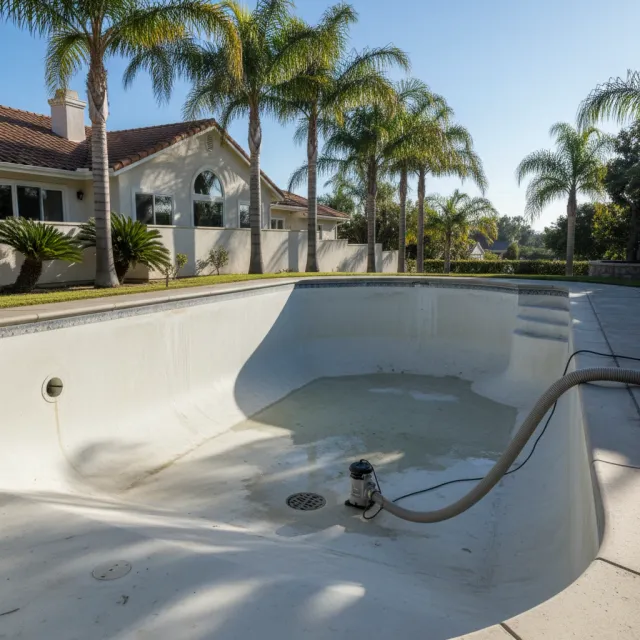
The cost to drain a pool in San Diego with PoolLogic is $750 for a full pool drain and refill. A spa or hot tub drain, clean, and refill is $350.
That flat price covers pump-out, a surface clean of the empty shell, compliant disposal, refill, and an initial chemical balance. It does not creep up on-site or turn into a wait-for-a-quote visit.
| Service | PoolLogic Price | Best For | Included |
|---|---|---|---|
| Full pool drain and refill | $750 flat | High calcium hardness, high cyanuric acid, high total dissolved solids, or work that needs an empty shell | Pump-out, shell surface clean, compliant disposal, refill, initial chemical balance |
| Spa or hot tub drain, clean, and refill | $350 flat | Cloudy water, high sanitizer demand, scale, odor, or routine water replacement | Drain, clean, refill, initial balance |
| Partial drain and refill | Usually less than a full drain | Water dilution when the shell does not need to be empty | Targeted water swap, lower shell stress, lower refill water use |
A full drain is not always the best answer. In San Diego, a partial drain often solves the chemistry problem with less cost, less water, and less stress on the pool shell.
If you want help choosing the right route, start with our pool draining and restart service. Share the pool size, surface type, access, and recent test results if you have them.
Do You Need to Drain the Pool?
The best pool draining cost San Diego homeowners can avoid is the one they do not need. We recommend a full drain only when chemistry or repair needs justify emptying the shell.
Most pool water problems fall into three buckets: total dissolved solids, calcium hardness, and cyanuric acid. Each can make water harder to manage, but not every high reading needs a full drain.
| Test | What it measures | Healthy target | When it points to dilution or drain |
|---|---|---|---|
| Total dissolved solids | Dissolved material | About 1,500 ppm above startup level as a benchmark | High sanitizer demand, haze, corrosion risk, or ongoing water issues. Partial drain or mobile reverse osmosis may solve it. |
| Calcium hardness | Dissolved calcium | About 200 to 400 ppm | Scale and cloudy water get harder to control past about 500 ppm. Our techs often flag a partial drain north of about 600 ppm; near 1,000 ppm may need reverse osmosis or drain-and-refill. |
| Cyanuric acid | Chlorine stabilizer | About 30 to 50 ppm, under 100 ppm | Well over 100 ppm, when chlorine acts sluggish and extra dosing stops helping. Partial drain is usually the first fix. |
Total Dissolved Solids
Total dissolved solids, or TDS, builds as water evaporates and leaves material behind. High TDS can raise sanitizer demand, haze the water, and speed corrosion.
Salt pools need a different read because they carry salt on purpose. Our own salt pools test at a median around 3,000 ppm, so an elevated TDS number alone is not a drain trigger.
Calcium Hardness
Calcium hardness is the trigger we see most often in San Diego. Local tap water is hard, so every refill and top-off adds more minerals.
Past about 500 ppm, scale and cloudy water get harder to control. In our service notes, readings north of about 600 ppm are where our techs usually flag a partial drain and refill.
Cyanuric Acid
Cyanuric acid protects chlorine from sunlight, but too much slows chlorine down. Across more than 5,000 of our own San Diego water tests, the median cyanuric acid reading is 40 ppm.
Well over 100 ppm, adding more chlorine can turn into a chase. Dilution is the fix, usually through a partial drain unless other problems point to a full drain.
When You Need a Full Drain, and When You Do Not
A full drain makes sense when water cannot be corrected through balancing, partial dilution, or filtration. It also makes sense when a repair needs an empty shell.
A Full Drain Often Makes Sense When
- Calcium hardness is extremely high and scale keeps returning.
- Cyanuric acid is well above 100 ppm and chlorine will not hold properly.
- Total dissolved solids cause ongoing haze, corrosion risk, or sanitizer demand.
- Plaster, resurfacing, or structural work requires an empty shell.
- The pool needs a close inspection of surface, tile, fittings, lights, or main drain cover.
You Usually Do Not Need a Full Drain When
- Stains can be treated with no-drain chemistry.
- Some leak work or drain-cover work can be handled underwater by a diver.
- Minor algae needs shock, brushing, filtration, and circulation.
- Some scale can be managed through chemistry before dilution is needed.
- High but manageable calcium or stabilizer only needs a partial drain.
Our first step is always a water test. If a partial drain solves the problem, that is usually our recommendation.
Resurfacing and plaster work are licensed-contractor construction. PoolLogic can coordinate drain timing around that work, but the construction quote and labor come from the contractor performing it.
What Changes the Price?
PoolLogic's full drain and refill price is $750 for typical San Diego and nearby service-area pools. The main variables are pool volume, site access, legal discharge path, and separate contractor work.
| Factor | How It Affects Cost |
|---|---|
| Pool size and volume | Larger pools take longer to drain and refill, and they raise the water bill the most. |
| Site access | Long hose runs, tight equipment areas, slopes, or difficult cleanout access can affect planning. |
| Legal discharge path | The water must go to an allowed route, not the street or gutter. |
| Full versus partial drain | A partial drain uses less water and is usually cheaper when it fits the chemistry problem. |
| Oversized pools | Oversized pools can cost more because pump time, water volume, and refill timing increase. |
| Separate contractor work | Plaster, resurfacing, or structural repairs are quoted and performed by licensed contractors, not included in routine drain service. |
The Water Bill Can Be $225 to $320 by Itself
The water bill is where San Diego pool owners are often surprised. As of 2026, City of San Diego single-family residential water is roughly $8.50 to $12 per hundred cubic feet, depending on tier.
One hundred cubic feet equals 748 gallons. A typical 20,000-gallon pool needs about 27 of those units to refill.
| Pool Volume | Approximate Water Units | Estimated Water Cost at $8.50 to $12 per Hundred Cubic Feet |
|---|---|---|
| 10,000 gallons | About 13.4 hundred cubic feet | About $115 to $160 before sewer or fixed charges |
| 15,000 gallons | About 20.1 hundred cubic feet | About $170 to $240 before sewer or fixed charges |
| 20,000 gallons | About 26.7 hundred cubic feet | About $225 to $320 before sewer or fixed charges |
| 30,000 gallons | About 40.1 hundred cubic feet | About $340 to $480 before sewer or fixed charges |
Landing in an upper usage tier can push a 20,000-gallon refill into the mid-$300s or higher. Sewer and fixed charges may also change what shows on the bill.
On a well, in Fallbrook, or in parts of Temecula, the math can differ. This is one of the strongest reasons to test first and consider a partial drain when it will solve the issue.
San Diego Risks: Hydrostatic Pressure, Timing, and Disposal
Draining a pool is not just moving water. In San Diego, the three major concerns are hydrostatic pressure, weather timing, and legal disposal.
Hydrostatic Pressure
Hydrostatic pressure is groundwater pressure pushing against the pool shell from the outside. When a pool is full, the water inside helps counter that pressure.
When the shell is empty, groundwater can crack or lift a plaster or gunite pool. Risk depends on the lot, recent rain, perched groundwater, clay soil, low-lying ground, canyon-adjacent areas, and whether the pool has a working hydrostatic relief valve or plug.
A hydrostatic relief valve or plug is designed to relieve groundwater pressure under the pool. Not every pool has one, and not every one works properly. Our team checks risk factors before opening a drain and keeps the shell empty only as long as needed.
Best Timing
The best time to drain is a dry-weather window. Avoid draining right after a storm because groundwater risk is higher.
We also avoid leaving exposed plaster sitting through a baking sunny stretch. The shell should refill promptly once the cleaning or inspection step is complete.
Our own drain jobs cluster from April through June as owners get ready for summer. Schedules tighten during that stretch, so booking ahead helps.
Legal Disposal
San Diego disposal rules are stricter than many owners expect. You cannot send pool water to the gutter and assume it is allowed.
City of San Diego compliant routes generally include:
- Gradual landscape absorption with no runoff.
- Sanitary sewer discharge through an approved on-site cleanout.
- Storm drain discharge only under strict conditions.
Storm drain discharge requires a clear flow path, dechlorinated water, ambient temperature, pH about 7 to 8, and no algae, algaecide, suspended solids, or salt. Saltwater pool water generally cannot touch the storm drain at all.
Clear large sewer discharges with Public Utilities first. If you do the work yourself, disposal compliance is your responsibility.
Do-It-Yourself Pool Draining Cost
A do-it-yourself drain can look inexpensive on paper. A submersible pump usually rents for about $40 to $70 per day, and post-refill chemicals often run $50 to $100.
That puts many DIY jobs around $100 to $200 plus the water bill. A careful owner can sometimes handle a simple partial drain on an easy pool.
| DIY Item | Typical Cost |
|---|---|
| Submersible pump rental | About $40 to $70 per day |
| Post-refill chemicals | About $50 to $100 |
| Refill water | About $225 to $320 for a 20,000-gallon City of San Diego refill at the raw water rate, before sewer or fixed charges |
The expensive risk is not the pump. It is an empty shell, groundwater pressure, weather timing, and disposal compliance.
A mismanaged drain can crack or float a plaster or gunite shell. That can turn a $750 service into a four- or five-figure structural repair. A professional service does not guarantee nothing can ever go wrong, but it stacks the odds away from the costly mistake.
What a Professional Drain and Restart Includes
A professional drain should start with testing, not pumping. The first question is whether draining is the right fix.
- Water test to confirm calcium, cyanuric acid, total dissolved solids, and balance.
- Decision between no drain, partial drain, reverse osmosis, or full drain.
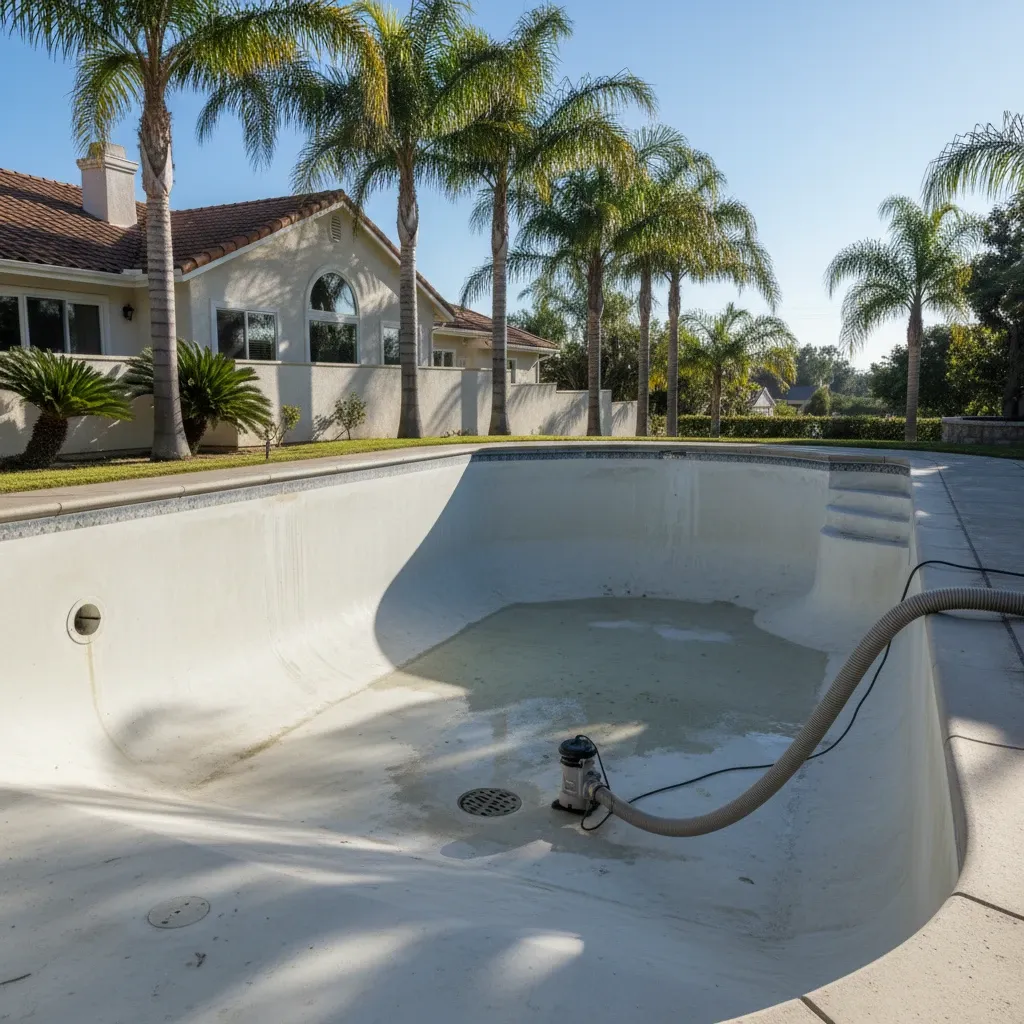
- Controlled pump-out that accounts for hydrostatic pressure and site conditions.
- Compliant discharge routing to an allowed path.
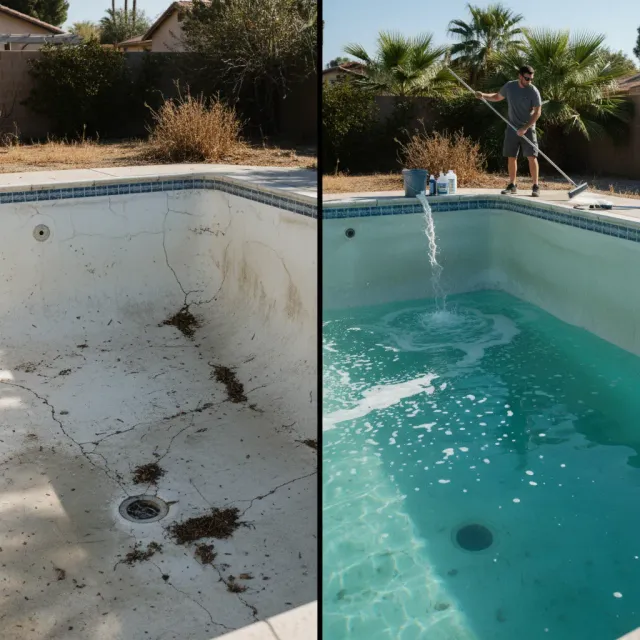
- Inspection and surface cleaning while the shell is empty.
- Fresh refill and initial chemical balance.
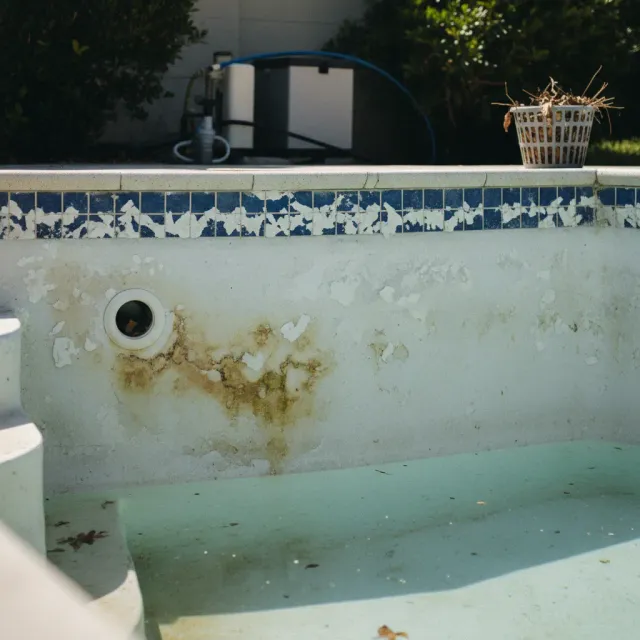
The empty shell gives the best view of the surface, tile, fittings, lights, and main drain cover. If something looks worn, cracked, or unsafe, that is the time to document it.
Chemistry usually needs circulation and a follow-up reading before it fully settles. We include the initial balance and explain what still needs to stabilize, rather than imply one visit makes every pool instantly swim-ready.
How Long Does a Drain and Refill Take?
Draining a residential pool usually takes several hours, depending on pool size and pump capacity. Refilling can take most of a day.
Because an empty shell should not sit, draining and refilling are scheduled close together. Our team plans the timing before the pump starts.
Fast Decision Guide
If you want the quickest answer, use this guide before scheduling a full drain.
| Situation | Likely Best Move |
|---|---|
| Calcium is high but not extreme | Partial drain and refill |
| Calcium is near 1,000 ppm | Reverse osmosis or full drain and refill |
| Cyanuric acid is well over 100 ppm | Partial drain, unless other issues support a full drain |
| Salt pool has elevated total dissolved solids | Interpret against salt level and symptoms before draining |
| Stains, minor algae, or normal cloudy water | No-drain treatment first |
| Plaster or resurfacing is scheduled | Full drain coordinated around licensed-contractor work |
PoolLogic's full drain and refill is $750 flat, and a spa or hot tub drain, clean, and refill is $350. If a partial drain is the smarter call, our team will say so.
For a quick quote, send the pool size, surface type, access notes, and any recent chemistry readings through our pool draining and restart service.
Frequently asked questions
How much does it cost to drain a pool in San Diego?
PoolLogic charges $750 flat for a full pool drain and refill. A spa or hot tub drain, clean, and refill is $350.
How much does the refill water cost?
A typical 20,000-gallon City of San Diego pool refill costs about $225 to $320 at the raw water rate, before sewer or fixed charges. Upper usage tiers can push it into the mid-$300s or higher.
Do I need a full drain or only a partial drain?
Many pools only need a partial drain, especially for high calcium hardness or cyanuric acid. Testing should come before any full drain.
How long does a pool drain and refill take?
Draining usually takes several hours, depending on pool size and pump capacity. Refilling can take most of a day, so the two steps should be scheduled close together.
How often should a pool be drained in San Diego?
There is no fixed schedule. Drain based on water tests, especially calcium hardness, cyanuric acid, and total dissolved solids.
Is it legal to drain pool water into the street?
Usually not by default. San Diego requires compliant disposal, and storm drain discharge is allowed only under strict water-quality conditions.
Can homeowners drain a pool themselves?
A careful owner may handle a simple partial drain, but a full empty shell carries hydrostatic, weather, and disposal risks.
What happens if a pool is left empty too long?
Groundwater pressure and sun exposure can damage the shell, including cracking or lifting in serious cases. Refill promptly.

Kyle Bowman
Founder of PoolLogic · CPO-Certified
Kyle is the Founder of PoolLogic Pool Service and a Certified Pool Operator (CPO) with deep expertise in pool service, water chemistry, and pool equipment repair. He oversees every aspect of PoolLogic's operations to ensure San Diego pool owners receive expert-level care.
Read moreNeed professional pool service?
PoolLogic Pool Service provides expert pool cleaning, maintenance, and repair services throughout San Diego County.