
On this page
- A hose drains a pool only when the outlet is lower
- Check the outlet, hose, and stopping level first
- Start the siphon without using your mouth
- Measure the flow instead of assuming an overnight drain
- Hard San Diego fill water changes the dilution calculation
- Choose a supervised window and a clear handoff point
A hose drains a pool only when the outlet is lower
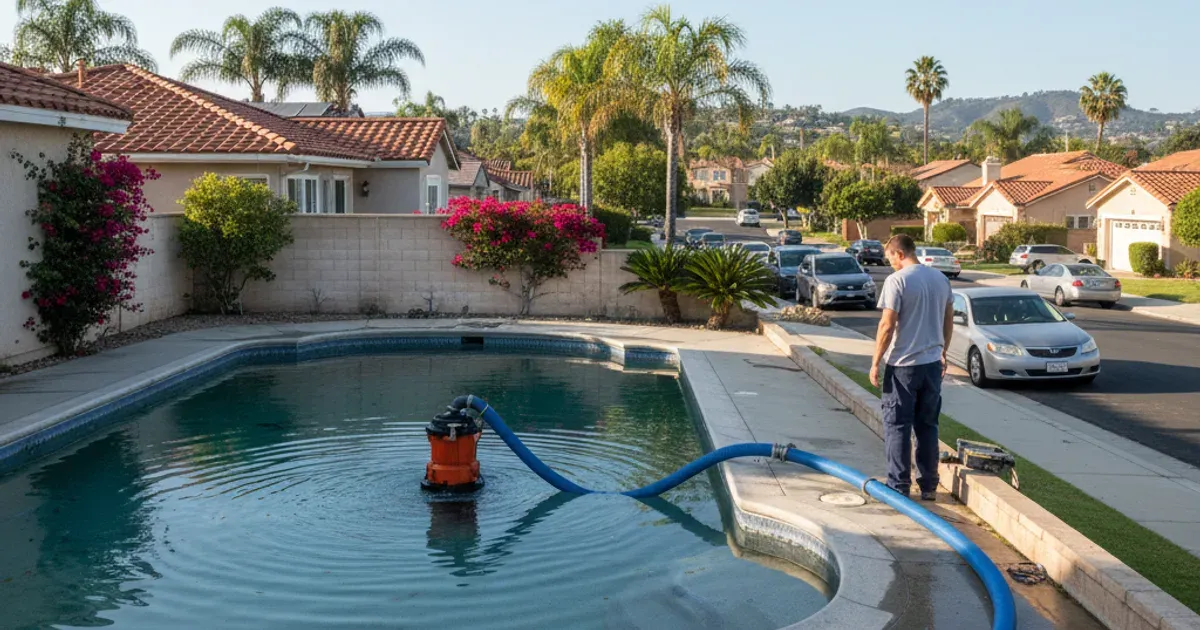
To drain a pool with a hose, fill the hose completely with water, keep one end submerged, and place the outlet below the pool’s water surface. Water will siphon out without electricity while the hose stays full and the outlet remains lower than the falling water level.
That familiar hose trick works for a controlled partial drain. It does not make every pool suitable for emptying. Before starting, choose a discharge destination accepted by your local wastewater or stormwater agency and establish a safe stopping level. An available downhill spot alone is not enough.
Stop adding chlorine, let the existing chlorine dissipate, and test before sending water to landscaping or any drain the local agency allows. Confirm that the tested water meets the agency’s discharge requirements before releasing it. Keep salt-system water off lawns and planting beds, even after chlorine dissipates, because dissolved salt remains and can damage plants. Where landscape discharge is allowed, spread the flow across an area that can absorb it. Slow or stop discharge if it erodes soil, pools, or runs toward a neighbor’s property.
For our San Diego County service area, we separate two decisions: whether a hose can move the water, and whether removing that water solves the problem. The first depends on elevation. The second depends on pool type, equipment, and water chemistry.
Check the outlet, hose, and stopping level first
Common advice says to put the hose downhill. More precisely, its outlet must sit below the water surface throughout the planned drain. A hose can pass over the pool edge, but its discharge end still needs that elevation difference.
| Check | Proceed when | Change the plan when |
|---|---|---|
| Outlet elevation | The outlet is below your intended stopping level. | The outlet is level with or above the pool water. |
| Hose condition | The hose is open, unkinked, and airtight along its length. | Cracks or loose connections admit air. |
| Discharge destination | The destination is accepted locally and can receive the flow. | You have not confirmed where the water may go. |
| Drain depth | You have a defined partial-drain target suitable for the pool. | You intend to empty the pool or cannot establish a safe limit. |
Use one continuous hose where practical. Each coupling creates another place for air to enter. Remove spray nozzles and avoid routing the hose across walkways.
Do not treat a slow hose as permission to empty an inground pool. Groundwater pressure can lift an emptied pool. Aboveground pools and liners also have manufacturer restrictions on lowering water. A garden hose changes the removal rate, not those limits.
Start the siphon without using your mouth
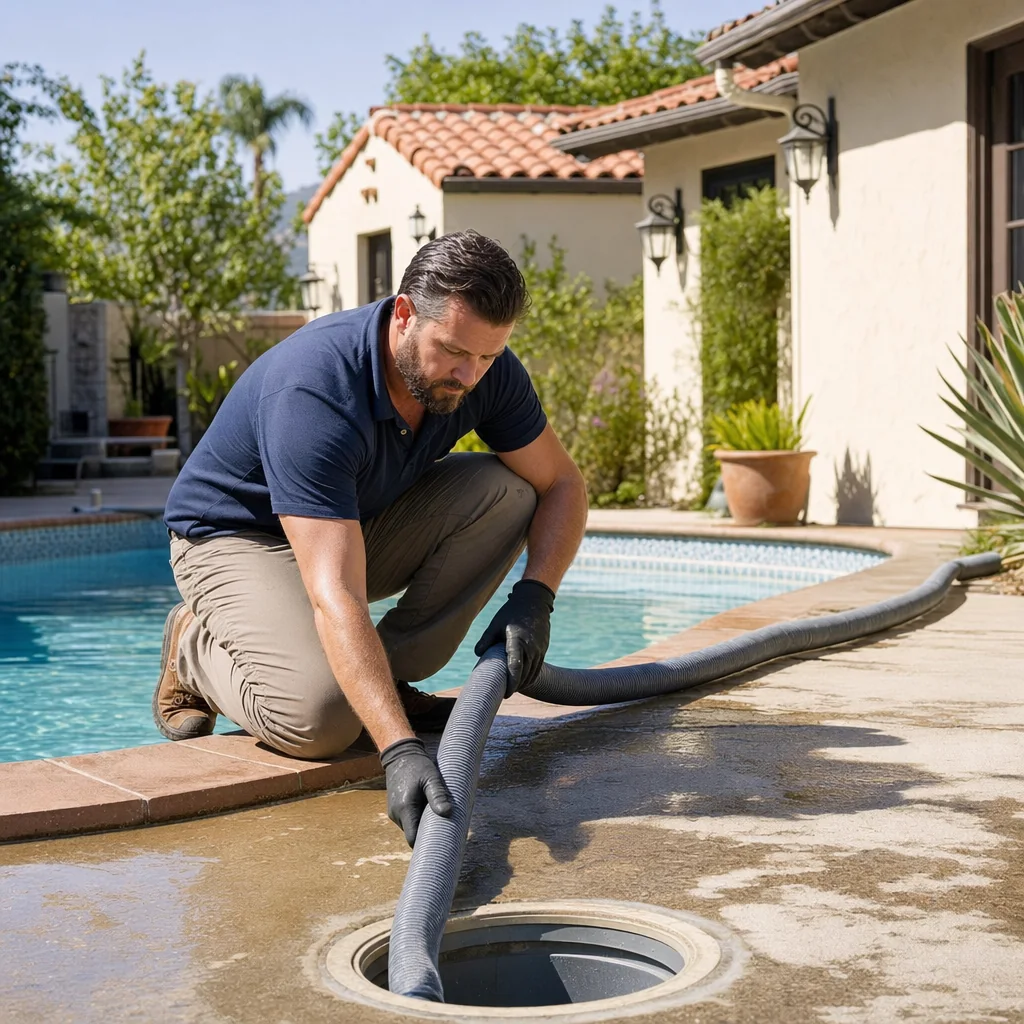
For a planned partial drain, the simplest priming method is to submerge the entire hose. You need a hose, a way to hold its inlet in place without damaging the pool, and a visible mark for the stopping level.
- Stop equipment that depends on pool circulation. Let a running heater complete its required cooldown. Then turn off the circulation system and prevent scheduled or remote starts during draining.
- Fill the hose underwater. Feed it into the pool gradually, allowing air to escape. Keep both openings submerged until bubbles stop.
- Keep the inlet underwater. Secure it below your planned stopping level, away from loose leaves. Do not attach it to a suction fitting.
- Seal the outlet temporarily. Cover that opening firmly while it is still underwater. Move it to the accepted discharge destination without letting the hose empty.
- Release the outlet below the pool’s water surface. Flow should begin once you uncover it. Secure the outlet so it cannot move.
- Watch both ends. Check the water level, inlet position, and discharge area throughout the drain.
- Stop at your marked level. Lift the inlet out of the pool to admit air and break the siphon. Allow water remaining in the hose to finish draining.
Never start a siphon by sucking on the hose. If flow does not begin, refill the hose underwater and check outlet height before trying again.
Measure the flow instead of assuming an overnight drain
The advice to leave a hose running overnight overlooks two problems: siphon flow varies, and unattended water can go somewhere unintended. Hose diameter, length, bends, and elevation difference all affect the rate. Flow usually slows as the pool level approaches the outlet height.
Measure the discharge using a container of known volume, keeping the outlet at its operating height. Divide the collected gallons by the collection time in minutes. For example, collecting 2 gallons in one minute means the current flow is 2 gallons per minute.
For a rectangular pool, each inch of water depth contains approximately:
Length in feet × width in feet × 0.623 = gallons per inch.
A 15-by-30-foot rectangle holds about 280 gallons per inch. Removing 2 inches means roughly 560 gallons. At a measured 2 gallons per minute, that would take about 280 minutes, or 4 hours and 40 minutes, if flow stayed constant. This is an illustration, not a promised hose speed.
Use the estimate to choose a period when you can supervise. If flow stops, check for an exposed inlet, trapped air, a kink, debris, or insufficient height difference. Do not connect the hose to an unidentified equipment valve to force faster drainage. Our technicians confirm suitable equipment connections after seeing the equipment.
Hard San Diego fill water changes the dilution calculation
Another common recommendation is to drain and add fresh water whenever minerals build up. That works only to the extent that replacement water contains less of the substance you want to reduce.
Most San Diego County tap water comes from imported supplies, including Colorado River and State Water Project water. It arrives hard and mineral-heavy. Test calcium hardness in both the pool and the intended fill water before choosing a replacement volume.
As a simplified example, replacing one-quarter of well-mixed pool water at 800 ppm calcium hardness with fill water at 300 ppm produces approximately 675 ppm. The calculation is 75% of the original concentration plus 25% of the replacement concentration. Those numbers illustrate dilution; they are not a target for every pool.
Hotter inland conditions increase evaporation, which leaves minerals behind. Refilling evaporation losses restores water level but does not remove accumulated minerals. Coastal marine-layer conditions generally reduce that evaporation pressure, but they do not make incoming water soft.
For a measured partial exchange, drain to the planned mark before refilling. Adding water while siphoning mixes replacement water into the discharge and makes the exchanged volume harder to judge. Use this approach only within the safe lowering limit established for your pool.
Choose a supervised window and a clear handoff point
A cool morning can make supervision easier, but weather alone does not determine whether draining is appropriate. During Santa Ana winds, leaves and dust can collect around the inlet quickly. Clear floating debris before starting and postpone the task if you cannot keep the inlet clear and watch the outlet.
Use these decision rules before committing to the hose:
- Small, measured level reduction: A siphon can work when outlet elevation, discharge destination, and pool limits are confirmed.
- No lower discharge point: A gravity siphon will not work. Have the drainage method assessed before selecting equipment.
- Large water exchange or uncertain chemistry: Establish the replacement volume and safe drain depth first.
- Full emptying or unknown pool restrictions: Arrange an assessment before removing water.
For a larger exchange, our pool draining and restart service can help establish the drainage and equipment plan. Have your pool type, approximate dimensions, recent test results, and proposed discharge location ready. To plan your budget, review our San Diego pool service pricing.
After a partial drain, restore the equipment’s required operating water level before restarting circulation. Confirm the pump primes and maintains flow before enabling the heater or salt system. Once the replacement water has mixed thoroughly, retest chemistry before adding corrective chemicals.

Kyle Bowman
Founder of PoolLogic · CPO-Certified
Kyle is the Founder of PoolLogic Pool Service and a Certified Pool Operator (CPO) with deep expertise in pool service, water chemistry, and pool equipment repair. He oversees every aspect of PoolLogic's operations to ensure San Diego pool owners receive expert-level care.
Read morePool service done right
Need professional pool service?
PoolLogic Pool Service provides expert pool cleaning, maintenance, and repair services throughout San Diego County.