
On this page
- A salt cell turns dissolved salt into chlorine
- First, test what is actually in the pool
- Match the reading or symptom to the next check
- Next, confirm that water reaches the cell
- Check salt and temperature before adding another bag
- Compare output percentage with daily chlorine demand
- Inspect the plates before deciding to replace the cell
- Record these details before requesting a production check
A salt cell turns dissolved salt into chlorine
A salt cell uses electricity to turn dissolved salt into chlorine as pool water passes between coated metal plates. This process, called electrolysis, produces the sanitizer that kills germs and controls algae.
The pump moves water through the cell. A power supply sends low-voltage direct current to its plates. Chloride from the dissolved salt becomes chlorine, which reacts with water to form the active sanitizer. A saltwater pool therefore uses chlorine, even when you rarely add chlorine by hand.
Much of that chlorine eventually returns to chloride, allowing the cycle to repeat. Salt does not evaporate with water. Water loss through splashing, leaks, or backwashing can remove it.
The cell makes chlorine; it does not filter dirt or measure whether the pool has enough sanitizer. Most basic systems follow an output setting and operating schedule. When chlorine falls, our technicians check the water, operating conditions, and electrical performance in that order.
First, test what is actually in the pool
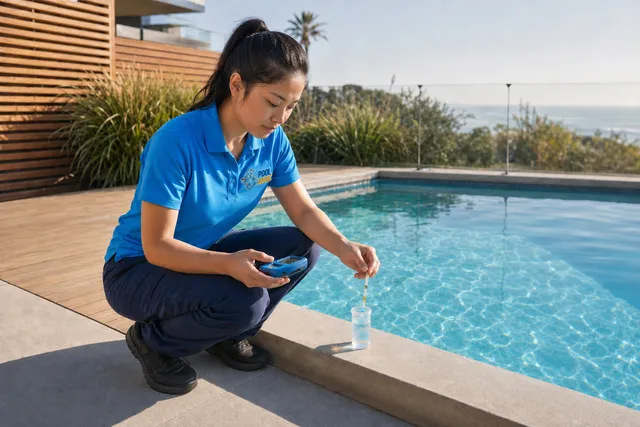
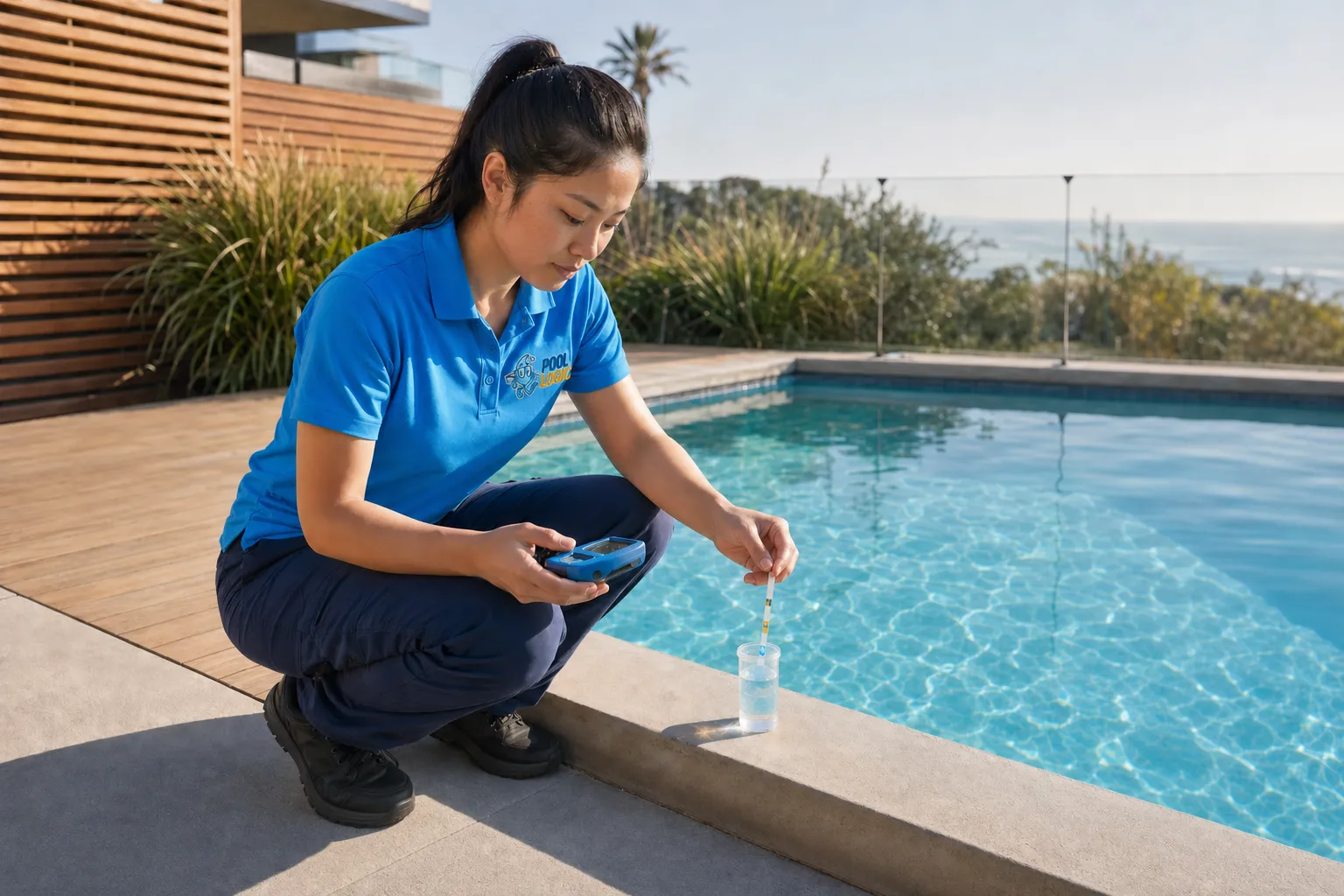
A glowing control panel cannot confirm that the pool has enough chlorine. We start with free chlorine, the chlorine available to sanitize the water. We also test pH and stabilizer, or cyanuric acid, which protects chlorine from sunlight.
For pools using stabilizer, CDC recommends at least 2 parts per million, or ppm, of chlorine and a pH of 7.0 to 7.8. These are baseline limits, not a complete operating target for every salt system. Follow the equipment guidance and account for the measured stabilizer level. See the CDC home pool water-testing guidance.
Too little stabilizer lets sunlight destroy chlorine quickly. Too much reduces chlorine's effectiveness at a given free chlorine reading. Neither condition proves that the cell has failed.
If free chlorine reads zero, keep swimmers out and restore the proper water balance before swimming. Increasing the output setting alone does not establish that the water is ready.
Match the reading or symptom to the next check
We use these checks to separate a cell that cannot run from one that cannot meet demand. Each symptom points to a test, not an automatic replacement.
| What you notice | What could explain it | What we check next |
|---|---|---|
| Low chlorine with a no-flow warning | The system has stopped production because it cannot confirm enough water movement. | Pump operation, baskets, filter condition, valve positions, and the flow sensor. |
| A low-salt warning despite a recent salt addition | Salt may be poorly mixed, or the displayed reading may be inaccurate. | An independent salt test, water temperature, and the cell's condition. |
| Production stops during cold weather | A temperature protection setting may be active. | Actual water temperature against the model's operating limits. |
| Normal status lights but chlorine keeps falling | Daily production may be below the pool's chlorine demand. | Stabilizer, debris, output percentage, and hours with adequate flow. |
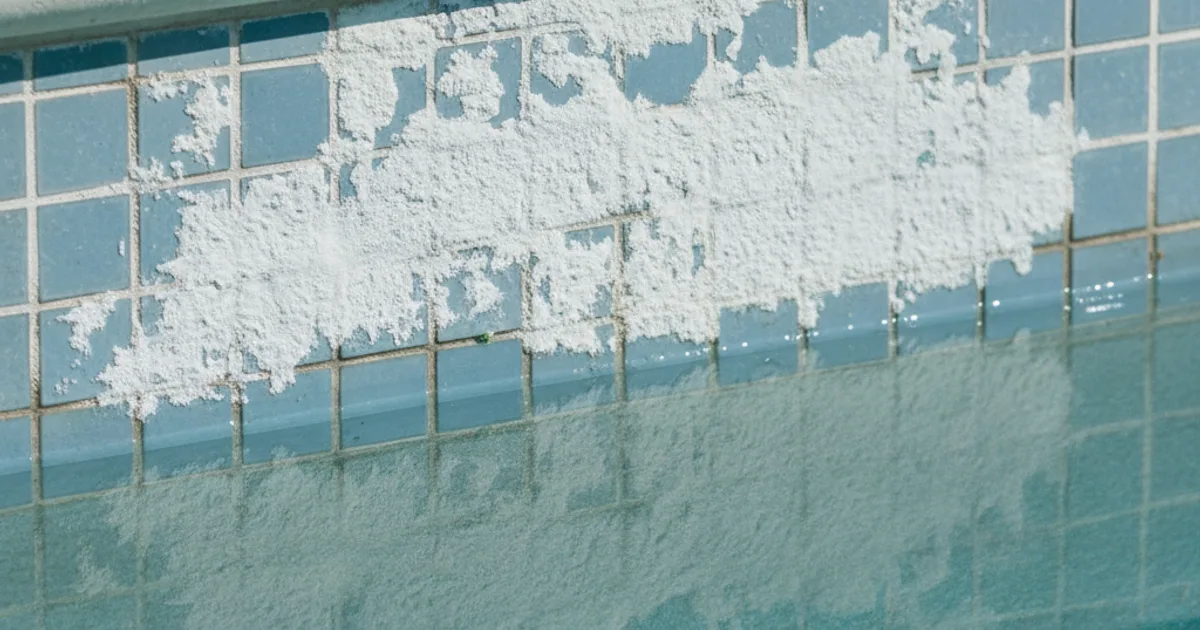
| White crust between the plates | Calcium scale may be interfering with operation. | Plate condition, pH, alkalinity, and calcium hardness. |
| Correct operating conditions but little chlorine production | The cell coating, power supply, or controls may have a fault. | Model-specific electrical readings and a controlled production test. |
Next, confirm that water reaches the cell
A running pump does not always provide enough flow for chlorine production. A variable-speed pump may circulate water at a setting below the salt system's required flow. A clogged basket or dirty filter can also restrict water movement.
We compare the actual pump schedule with the hours the cell can operate. If the pump runs eight hours but sufficient flow exists for only four, the cell has a shorter production window.
The flow switch is a safety device. Electrolysis also produces hydrogen gas, which flowing water carries away from the cell. Never bypass a no-flow warning or force the generator to operate without circulation.
For a homeowner, the useful check is whether the warning appears only at certain pump speeds or scheduled times. Record that pattern before changing settings.
Check salt and temperature before adding another bag
The correct salt level comes from your specific cell's manual. There is no single target that fits every generator. More salt does not automatically mean more chlorine, and excessive salt can trigger a shutdown.
We compare an independent salt measurement with the controller's display. A mismatch calls for checking the sensor, temperature, and cell condition before adding salt.
Evaporation makes this especially relevant in inland San Diego County. Water evaporates while salt stays behind, temporarily raising its concentration. Restore the normal water level and allow circulation before judging the salt reading.
Cold water can reduce or stop production, depending on the model. The relevant number is the water temperature, not the afternoon air temperature. Check the model's cold-water limit before treating a winter shutdown as cell failure.
Compare output percentage with daily chlorine demand
A setting of 50% does not mean the pool contains half the chlorine it needs. On many systems, it means the cell produces chlorine for roughly half its available operating time.
For example, eight operating hours at 50% provide about four equivalent hours at full output. Four hours at 100% provide approximately the same theoretical production, assuming suitable flow and operating conditions. Neither example is a recommended schedule for every pool.
The cell's rated production, often listed in pounds of chlorine per day, describes its capacity under specified conditions. Pool size, sunlight, swimmers, and contamination determine whether that capacity is enough.
Inland summer heat can raise chlorine demand beyond a schedule that worked during mild coastal weather. Santa Ana winds can also bring leaves and dirt that consume chlorine. Remove debris and compare water tests taken at similar times before assuming the equipment has worn out.
If chlorine stays stable after a measured output adjustment, replacement is not the first step. If it keeps falling at maximum output, we check both actual production and unusual chlorine demand.
Inspect the plates before deciding to replace the cell
White deposits on the plates are calcium scale, a hard mineral buildup. San Diego County's hard source water supplies calcium, and evaporation concentrates minerals further. Conditions near the operating plates can encourage deposits even before obvious scale appears elsewhere.
We check pH, alkalinity, and calcium hardness together. Alkalinity helps resist pH changes; calcium hardness measures dissolved calcium. Cleaning deposits without correcting the water balance can leave the same problem returning.
Many cells reverse electrical polarity to help limit scale. That feature does not eliminate inspection. Follow the manufacturer's inspection interval and cleaning instructions. Our salt cell cleaning guide explains the separate cleaning decision.
Before opening equipment, shut off power and follow the pressure-release procedure. Never scrape the coated plates with metal tools.
If the plates are clean and operating conditions are correct, our technicians check electrical performance against the model's specifications. Worn plate coatings can reduce output, but calendar age alone is not a replacement test.
Record these details before requesting a production check
For a useful assessment, gather the readings that show when production falls behind:
- The cell model and exact warning message.
- Free chlorine, pH, stabilizer, and independently tested salt level.
- Water temperature and output percentage.
- Pump operating hours and any speed changes.
- Recent heavy swimming, windblown debris, or water replacement.
Keep electrical covers closed and leave internal testing to a technician. Our salt water pool repair service in San Diego County can check production and confirm whether the next step is a setting change, maintenance, repair, or cell replacement.

Kyle Bowman
Founder of PoolLogic · CPO-Certified
Kyle is the Founder of PoolLogic Pool Service and a Certified Pool Operator (CPO) with deep expertise in pool service, water chemistry, and pool equipment repair. He oversees every aspect of PoolLogic's operations to ensure San Diego pool owners receive expert-level care.
Read moreNeed professional pool service?
PoolLogic Pool Service provides expert pool cleaning, maintenance, and repair services throughout San Diego County.